Thursday, May 17, 2018

May 1918: “Trust In God. Hold Your Head High and Fly the Service Flag.”

by Captain William Carraway
Historian, Georgia Army National Guard


By May, the grim reality of trench warfare had set in for the men of the 151st Machine Gun Battalion. In the two and a half months the 151st spent occupying the relatively quiet Baccarat sector they were exposed to regular direct and indirect fire as well as gas attacks and probing actions. Life in the trenches was unsanitary, boring and terrifying.

Letters from home provided the only relief from the dull routine and tense waiting while reminding the Soldiers that a world existed outside the scarred landscape of France. Corporal Robert Gober Burton’s aunt Mary Eulalia Gober wrote frequently to him and the other Soldiers in the 151st from Monroe, Ga. One of the Monroe Soldiers, Sgt. Tom Hensler, wrote back:

In the Trenches
Gas-proof shelters for dressing stations, near Badonviller, Baccarat Sector,
April 29, 1918. Photo from The Medical Department of the United States Army
in the World War, 1925
.
April 28, 1918
Mrs. W. H. Nunnally
Monroe, Ga,
My very dear Mrs. Nunnally
Received your card yesterday and was glad to know that there was still one in my old home town that hadn’t forgotten me altogether.

Wednesday, April 25, 2018

The Georgia Volunteers in the Spanish American War


by Captain William Carraway
Historian, Georgia Army National Guard

On April 25, 1898, the United Stated declared war on Spain following the destruction of the U.S.S. Maine in Havana Harbor. The Treaty of Paris ended the war December 10, 1898. The conflict sandwiched between those dates would be referred to by Col. Theodore Roosevelt as a “splendid little war.” Indeed, the Spanish American War is in large part remembered for the flourish of Roosevelt’s Rough Riders who fought side-by side with the African American Soldiers of the 9th Cavalry Regiment at Kettle Hill and San Juan Hill. The war marked the emergence of the United States as an international power. Victory granted the United States the Spanish colonies of the Philippines, Puerto Rico and Guam and heralded the political rise of Theodore Roosevelt and the progressive movement. But despite the glory of Roosevelt’s “crowded hour,” the Spanish American War would have a deleterious effect on many of the Citizen Soldiers from Georgia who volunteered for service.

Brig. Gen. Phill G. Byrd. Georgia's Adjutant
General, 1900. Georgia Guard
History Archives
On October 17, 1900, the report of the Adjutant General of the State of Georgia for 1899 to 1900 was delivered to Georgia Governor Allen D. Candler. Brigadier General Phill G. Byrd, Adjutant General of the Georgia State Troops, in his foreword to the Governor noted: “…on January 1st, 1899, because of the demoralization growing out of the Spanish-American War, and other causes, the State Troops had become so badly disorganized as to exist in name only.” It is worth exploring what events caused the great demoralization the adjutant general lamented. What organizational ennui befell the Georgia State Troops as a result of their involvement in the Spanish American War?


Background

As 1898 dawned, the modern concept of the National Guard was in its infancy. In Georgia, the military establishment was known as the Georgia Volunteers and would be known thus until a December 21, 1899 act changed the name to the Georgia State Troops. The Volunteers had an authorized strength of more than 12,000 men, but an organized strength of less than 5,000. The Volunteers were organized into six regiments and four battalions of infantry; one regiment, one battalion (not squadron) and one troop of cavalry; three batteries of artillery, a machine gun battery and four companies of Naval Reserve Artillery. African American Citizen Soldiers constituted  three of the infantry battalions, one troop of cavalry and one battery of artillery in the then segregated Volunteer structure.

Thursday, April 5, 2018

April 1918, Back to Baccarat: “They are putting our names down in history it looks like.”

by Captain William Carraway
Historian, Georgia Army National Guard

When the units of the 42nd Division pulled out of the trenches March 23, 1918 they were initially dispatched for further training in the Rolamport area. (MWW, 91) These orders were countermanded due to the spring German offensive and the 151st MGB instead marched to Badmenil March 28, 1918. They did not have long to wait. On March 30th, the 151st received orders to move with its supported units to new positions in the Baccarat Sector. Major Cooper Winn established battalion headquarters at Neufmaison with the 84th Brigade HQ while Company A and B marched with the 167th Infantry Regiment and took up support by fire positions at Vacqueville. From there, they rotated into front line positions near Neuviller or Grand Bois. Companies C and D, moving with the 168th Infantry moved to Pexonne and entered front line positions in Badonvillier and Village Negre.

Upon arriving in Vacqueville, Cpl. Robert Burton humorously advised his family about life in the trenches in spring.

Thursday, March 8, 2018

March, 1918, First Contact: “The Boche haven’t got me yet!!”

by Captain William Carraway
Historian, Georgia Army National Guard


On March 7, Private Robert Addleton stepped through the door of his home at 6 Holt Avenue in Macon for the first time in more than six months. He was the first member of the 151st Machine Gun Battalion to return from the war. After enlisting April 17, 1917, Addleton had traveled to France with the battalion and ultimately to within 10 miles of the Western Front. Mere days before the 151st entered the front-line trenches, it was discovered that Addleton had been underage at the time of his enlistment. He was sent home with an honorable discharge. While his comrades were overseas receiving their baptism of fire, Addleton went back to work at the Willingham Cotton Mills in Macon. 


Somewhere in France (The trenches near Ancervillier)
March 14, 1918
My dearest daddy,
Your letter received today. I was surely glad to hear from you. I am getting along well and fine. Tom Hensler is getting along just as nicely as can be. So is (Private Weymon Guthrie, Company B; Pvt. Leonard Chandler, Company B) and old Moore (Emory Moore, Company C.) You couldn’t kill him. Tom is just as full of life as ever, keeps you laughing all the time. (Sergeant Ed Williamson, Company A) is with us now. He rejoined us about a month ago I suppose. I was as glad to see him as if he had been my own brother.

Corporal Robert G. Burton’s March 14th letter offers a reassuring version of the war in which he and his fellow soldiers are happy and in high spirits. Perhaps knowing that any correspondence sent home would be widely distributed among family members and shared with the local paper, Burton provides no hint of his location or the fact that Soldiers of his unit had been in the trenches for nearly a week. in the Luneville and Baccarat sectors.

Sectors in the Vosges Front, 1918. Map by Capt. William Carraway from
American Battle Monuments Commission data.


Thursday, February 1, 2018

"Don’t worry for a minute about me." Training for the Trenches: January-March 1918

by Captain William Carraway
Historian, Georgia Army National Guard

Private Joseph Tucker obituary
Atlanta Constitution, Jan. 25, 1918
The 151st Machine Gun Battalion trained at Viller sur Suize for five weeks enduring more severe cold. Weather and hardship took a toll. Private Joseph E. Tucker of Company C died of pneumonia shortly after the battalion reached Viller sur Suize. A resident of Brinson, Ga., Tucker told recruiters he was 18.5 years old when he enlisted in Company E, 2nd Georgia Volunteer Infantry June 25, 1917. When he died January 10, 1918, Tucker was just nine days short of his 16th birthday.

While at Viler sur Suize, the Soldiers familiarized themselves with gas mask drills and practiced emplacing and firing their Hotchkiss machine guns. The Mle 1914 Hotchkiss Machine Gun was capable of firing 600 eight-millimeter rounds per minute. A squad of nine men was required to maintain and serve a Hotchkiss in combat. The squad was led by a corporal and consisted of eight privates. The gunner carried the 53-pound weapon in action while an assistant loader bore the 41-pound tripod. A third man was responsible for carrying the 18-pound traversing rod along with an ammunition box containing 30-round strips of ammunition. Three men served as ammunition carriers and two more were detailed to handle mules who hauled the gun cart and ammunition cart. These carts would be driven as close as possible to firing positions before the guns were carried forward by hand. In practice, road and terrain conditions often necessitated long maneuvers carrying the weapons and ammo distributed amongst the squad members.

In this 1918 Signal Corps photo, Major Cooper Winn, commander of the 151st
Machine Gun Battalion reviews machine gun squad drill with officers of the French Army.

Burdened with more than 100 pounds of weapon system in addition to ammunition crates, the Soldiers were not assigned individual weapons systems. Their lives on the battlefield would depend on how fast they employed their machine guns and how accurately they could place fire.

The companies of the 151st Machine Gun Battalion consisted of three platoons, each commanded by a lieutenant along with a headquarters section. The platoons had two sections composed of two squads. A sergeant led each section while corporals were responsible for the squads. On January 23, Robert Burton was promoted to corporal and placed in charge of one of those squads. The occasion prompted his first letter home since January 6, 1918.

Somewhere in France (Viller sur Suize)
January 23, 1918
My dearest mama,
As I haven’t received a letter from you in sometime will drop you a line.
I am getting along just as nicely as possible.
I had a letter from Mildred some two or three days ago. She said that she heard from you quite often. Good work. Keep it up. She also said that she sent me an Xmas present but so far it hasn’t been received yet.
Tomorrow I am taking out $5,000 more of insurance. I am doing it mostly to do my bit in saving the government money. Not that I think that I am going to be hurt in the war. I am also going to notify the man in charge of the war risk insurance to send the policy to you That means the first $5,000 I took out but after a while you will get the policy on the second $5,000.
How is everything and how are everybody at home? Write me with the news.
Don’t worry for a minute about me. With heaps of love,
Your Devoted Son,
Gober

Private Homer Terry's grave marker, Meuse Argonne
Cemetery. Photo courtesy of Jack Solomon
By mid-February the battalion was ordered to prepare to move to the front. The Soldiers entrained February 18, 1918 for transport initially to Giriviller, about 20 miles southeast of Nancy. Five days later, Pvt. Homer Terry of Company B was run over by a machine gun cart and killed. Terry was from Porterdale, Ga. He had enlisted in The Jackson Rifles, Company A, 2nd Georgia Volunteer Infantry June 16, 1916 and had traveled with Burton to Camp Cotton on the Mexican border that year. He was 23 years old.

At Giriviller, the companies of the 151st were attached to the infantry regiments of the 84th Brigade, 42nd Division. Company A and B were attached to the 167th Infantry Regiment comprised mostly of National Guard Soldiers from Alabama while Company C was attached to the 168th Infantry Regiment composed of Iowa National Guard Soldiers. The newly assigned Company D was attached to a reserve element of the 168th.
Major Cooper Winn, commander of the 151st Machine Gun Battalion was assigned as machine gun officer for the 84th Brigade in addition to his battalion command duties. The 27-year-old native of Macon enlisted as a private in the Macon Volunteers March 2, 1899 and was commissioned a second lieutenant in the same unit three years later. He served with the Macon Volunteers until 1912 when he was appointed adjutant of the 2nd Georgia Infantry Regiment, parent unit of the Macon Volunteers. Promotion to major followed in November 1912. Major Winn traveled with the Georgia Brigade to El Paso, Texas in 1916 and was stationed at Camp Cotton at the same time as Cpl. Burton. Winn assumed command of the 151st Machine Gun Battalion in August 1917 after the Georgians returned from Texas.

The Macon Volunteers in 1903. Lieutenant Cooper Winn stands center.
Georgia National Guard Archives

For now, Winn’s focus was on rotating his companies through front line positions in the Luneville and Baccarat Sectors, relatively quiet sections of the front but still part of an active combat zone. These sectors occupied gently rolling terrain north of the mountainous Vosges Region near the Swiss border. Here, the 151st and their supported infantry regiments would begin working with the French 128th Division prior to conducting a battle-handoff of sector responsibility.

On March 8, the first elements of the 151st Machine Gun Battalion entered the trenches near Badonvillier beginning the first of 167 days in front-line combat positions.


Next Chapter: First Contact

Monday, January 1, 2018

"Today, a year ago, I was in Texas. Today I am in France." November 1917-January, 1918.

by Captain William Carraway
Historian, Georgia Army National Guard

When the U. S. S. Agamemnon sailed out of Hoboken it carried not only the 570 officers and men of the 151st Machine Gun Battalion but the hopes and prayers of thousands of family members back home who would wait, pray, and scan the newspapers for casualty reports. News would come days late, if at all through letters back home, heavily censored by company officers to remove referenced to specific locations, times and casualties. 

The voyage of the Agamemnon was largely uneventful for the crammed Soldiers who passed the time smoking, playing cards and listening to music on a handful of gramophones. The only event of note took place on the evening of November 9 when the transport Von Steuben collided with the Agamemnon burying her bow in the Agamemnon’s port side. Fortunately, the hole caused by the collision was above the water line and repairs were swiftly made. The majority of the men likely had no idea at the time what incident had befallen their ship and would only learn of the events through the second-hand gossip.

U.S. Navy troop transports at sea, November 10, 1917. These ships, steaming in convoy from New York City to Brest, France, are (from left to right): USS Mount Vernon (ID 4508), Agamemnon and USS Von Steuben (ID 3017). Note the damage to Von Steuben's bow, the result of a collision with Agamemnon on the previous day. U.S. Navy Photo NH 57750


Three days later, November 12, 1917, land was sighted, and the Agamemnon and other ships of her convoy sailed into Brest Harbor. Due to the shortage of resources to unload the ships and lack of transportation and lodging, the Soldiers remained aboard the Agamemnon an additional five agonizing days.

Finally, on November 17, 1917, the men disembarked and crowded forty at a time into railroad cars. Issued three days rations, the men remained in the cars until the 22nd of November when they detrained at Vaucouleurs. Without issue of rations, the battalion was split up and elements marched in a pouring rain, Company C going to Vaux la Petite while Company A, B and Headquarters marched to Uruffe.

Having arrived at their initial training stations, the companies of the 151st MGB conducted nearly a month of training before beginning a 110-kilometer foot march to their new station in the Rolamport sector. Marching in heavy snow on December 14, the entire Battalion assembled at Manois where it remained through Christmas, 1917.


Nov 21-Dec 26, 1917: The 151st MGB arrived by train in Vaucouleurs Nov. 21, 1917. Detraining on Nov. 22, the Bn. split with Co. C taking station in Vaux La Petite while HQ, A, and B moved to Uruffe. The companies remained in place until Dec. 12, when they began a 150 kilometer march to the Rolamport Area. Company C marched from Vaux la Petite to Bure while HQ, A and B marched from Uruffe to Verseignes (location estimated. On Dec. 13, HQ, A and B advanced to Domremy while Co. C marched to Germisay. On Dec. 14, during a heavy snow storm, the battalion assembled in Manois.
Battalion movements shown in yellow.  White indicates Co. C while Green shows the movements of HQ, A and B.
Source:  “Vaucouleurs.” 48 00’15.49”N 6 16’01.44”E. Google Earth. Landsat/Copernicus. Dec. 31, 2017.


.
Burton’s correspondence is uncharacteristically spotty from the time the 151st MGB boarded the Agamemnon to Christmas with only three letters making their way home to Monroe. The first letter was a post card informing his family that he was shipping and would write soon. The second letter would not come until Company A had completed its march to Uruffe. Writing thus on November 28, Gober noted that he was well and asked for his family to send soap and tobacco.

When next he had a chance to write, Gober was in Manois.

Somewhere in France
December 18, 1917
My dearest mama,
Well, I have another chance to write. I am getting along fine. Sleep warm at night and get to stay around a stove when we are not at work in the daytime.
I have received about three or four letters from you since I have been over here. I have written to you three times since we sailed. I suppose you have gotten all those by now and I hope that you have started me a box for Xmas. Please send me plenty of tobacco.
Write a check on me and buy a Ingersol Junior watch and send it to me. I have broken the crystal on mine and haven’t got a chance to get one.
Mildred wrote me that she was coming up in Ga. Xmas and that she might come by Monroe. I hope that she does because I want you to know her.
Don’t worry for a minute about me for I am getting along just as fine as can be. Uncle Sam is taking care of me.
Will write to you every chance I get. Write every week.
Your devoted son,
Gober

The day after Christmas the 151st MGB was again on the march. For these Georgian soldiers, the constant snow storms and freezing temperatures added a particular layer of misery to an otherwise tedious affair of endless marching with heavy packs and blanket rolls. 

Dec 26 1917-Jan 4, 1918: HQ, A, and B marched to Treix Dec. 26, 1917 while Co. C moved to Blancheville. The next day, Co. C advanced to Crenay by way of Chaumont. On Dec. 28, 1917, HQ, and Co. A marched to Vieux Moulins while Co. C and B congregated at Leffonds. On January 14, the battalion was reunited at Villers-sur Suize where they received an additional company from the Penn. National Guard, Company B, 149th MGB.  This company became Co. D, 151st MGB.
Battalion movements shown in yellow.  White indicates Co. C while Green shows the movements of HQ, A and B.
Source:  “Vaucouleurs.” 48 00’15.49”N 6 16’01.44”E. Google Earth. Landsat/Copernicus. Dec. 31, 2017.

By January 1, 1918, Burton was able to write home.

Corporal Burton's letter home Jan 1, 1918. Georgia Guard archives.

Somewhere in France (Vieux Moulin)
January 1, 1918
My dearest mama,
Well! Today a year ago I was in Texas. Today I am in France. I am getting along just as fine as possible. The Xmas boxes haven’t been given out yet, but we will get them before long.
How is everything at home? Write to me as often as you can, and I will do the same, but my chances are not so good as yours.
I had a nice letter from Mildred on Xmas day. Also, two or three from you. One from Rache (Burton’s brother) saying that he was sending me some cigarettes.
I wrote you telling you to send me some toilet articles and tobacco. Here is what I want. Don’t send them too often. Don’t forget the Ever Ready safety razor blades. That is the only thing I am short on now. When you send me tobacco send Prince Albert smoking tobacco. Cigarettes are too hard to carry about and Prince Albert don’t get damp so quickly as cigarettes. That doesn’t mean to say not to send any cigarettes. Mix them up.
Don’t you worry about me for I shall be OK.
Wish that I could have been at home during Xmas. Did Mildred come by Monroe during Xmas? She wrote me that she was coming up into Ga. Xmas and that if possible she was coming by Monroe.
I am sitting in the middle of the floor writing this by candlelight. The place is warm, and I am comfortable. You know how I used to write …. On the floor at home.
Write me soon.
Your devoted son,
Gober

On January 4, 1918, the 151st Machine Gun Battalion assembled at Viller sur Suize with the addition of a company from the 149th Machine Gun Battalion. This company of Pennsylvania National Guard Soldiers formed Company D of the 151st MGB. That same day, the 151st lost its first Soldier, Private Edgar Coots. While the Atlanta Journal Constitution reported that Coots death was due to gunshot wounds, it is far more likely that Coots was killed in an accident as reported by the battalion in the post-war account The 151st Machine Gun Battalion, Rainbow (42D) Division.  

Viller sur Suize would prove to be a more or less permanent training station until the battalion was called to move into the trenches. Here the battalion received their Hotchkiss machine guns, helmets, gas masks and final equipage. The men also received overdue Christmas packages from home as Burton related in his letters back home.

Corporal Burton's letter home Jan. 6, 1918.


Somewhere in France (Viller sur Suize)
January 6, 1917 (1918)
My dearest mama,
Well, I received the Xmas boxes last night. All of them came together. They were surely appreciated. From what you and Auntie sent you had not received the letter that I wrote you on the boat. I wanted some razor blades, but you can send them later.
I am getting along just as nicely as possible. Haven’t been sick yet.
Two letters came last night from Mildred. She said that she had had a nice letter from you. I like to hear about that.
I haven’t cut the first cake yet, but I can tell by the smell that it is fine. I gave a lot of the boys some of the candy and they seemed to enjoy it very much and I know that I did.
I don’t know how much truth there is to it, but we have been hearing peace rumors over here. Here’s hoping that it is so.
I received a box of cigarettes from Rache a day or so ago. Please when you write to him, thank him for me.
Mildred’s letter said that she was sending me a package. I can’t imagine what it is.
I think that it won’t be long before we come back to the States. Don’t you for a moment worry about me.
Write me as often as once a week anyway,
As ever,
Your devoted son,
Gober

Burton paints a cheery picture for his family at home. At no point does he relate the misery of the train ride to Vaucoulers or the extended road marches, first in freezing rain and then in deep snow, clad in only wool uniforms and a great coat. The next few weeks would pass in relative safety 70 miles from the front, but the 151st would presently enter the front lines, and suffer their first casualty.

Next Chapter:  Training For the Trenches 

Wednesday, December 13, 2017

“If I ever have a son and he says I want to join the Army I am going to beat him nearly to death.” Camp Mills, September-October, 1917

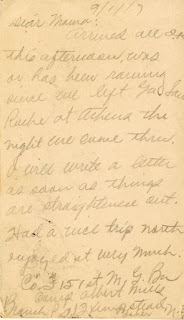
Robert Burton's Letter, Sept. 17, 1917
by Captain William Carraway
Historian, Georgia Army National Guard

Camp Albert Mills, N.Y.
September 1, 1917
Dear mama,
Arrived all OK this afternoon. Was, or has been raining since we left Ga. Saw Rache (Gober’s Brother) at Athens the night we came thru.
I will write a letter as soon as things are straightened out.
Had a nice trip north. Enjoyed it very much.
Co. F 151st MGB Camp Albert Mills Branch PO 12
Hempstead, N.Y.
Gober

Camp Mills, located near Hempstead, New York, was named after Maj. Gen. Albert L. Mills who received the Medal of Honor for actions during the Spanish American War. Established in September 1917, Camp Mills soon became the largest training center for troops bound for France from the nearby port of Hoboken, N.J. It was here that the 151st Machine Gun Battalion would become part of the 42nd Division.

The 151st Machine Gun Battalion was formed from Companies B, C and F of the 2nd Georgia Infantry Regiment. In addition, the MGB absorbed non-commissioned officers such as Burton from other companies. The transfer was accomplished August 13, 1917. With the addition of Soldiers from the 1st Georgia regiment, the battalion reached a strength of 591 officers and enlisted men before embarking for Camp Mills.

Burton’s original assignment in Company F, 2nd Georgia was changed to Company A 151st Machine Gun Battalion while companies B and C of the 2nd Georgia were assigned as Company B and C of the new battalion. It seems that the new arrangement took some time to be accomplished according to Burton’s letter of September 1 and 3, 1917.
Robert Burton's return address, Sept. 3, 1917

Camp Mills, Sept 3, 1917
My dearest mama,
Well! I am actually on Long Island New York. What do you think about that?
The funniest thing up here is the way the people talk. You can hardly understand what these Yankees say. Another thing that is queer to the southern boys is that Coca Cola is hardly known at all. But the people treat us fine. Will do anything that they can for you and especially for the southern soldier. They seem to like them very much.
When we unloaded it was raining but I think that before long the weather will clear up and we will like the place OK.
We had a nice trip up the river yesterday morning. Had a good view of New York City.
My address is
Co. F, 151st MGB
Camp Albert Mills
Hempstead, N.Y.
Branch PO
Your devoted son,
Gober

Within two weeks of his arrival, the well-traveled Gober wrote of his latest exploits.

Robert Burton's Letter of Sept. 17, 1917

Camp Mills, Monday Night (September 17, 1917)
My dear mama,
Well! I have taken in New York and Coney Island. New York is some big town believe me. I like big crowds and a city, but this suits me most too well. I have ridden on a subway, the elevated and the surface cars. I have seen Broadway by night. I have seen 5th Ave. in the late afternoon. I have seen Chinatown and the Bowery. Also, have seen Central Park, Madison Square Garden, the Flat Iron Building, the Woolworth Building and all the famous parts of N.Y.
I have been to Coney Island during Mardi Gras week and have seen all the wonders there. But greater than that would I rather see my little old mother and father way down in Ga.
Your devoted son,
Gober

In his letter of September 27, 1917, Burton responded to his family’s concern for his well-being and uncertain future.

Camp Mills
Thursday night, September 27, 1917
My dearest mama,
Tho I haven’t heard from you in a day or so, will write you tonight as it is likely that I will not get to write to you again in some time. I heard today that this was the last night that we would be allowed to write. After this, all of our mail will be censored. It looks now like we will sail before long. From where, I don’t know, or I don’t when, but I played safety first and wrote tonight so that if it was so, I would have written.
Now mama, please don’t you worry about me. I am not looking on the dark side of this so please don’t. Ed had a letter from Wheeler (Will) Mears the other day. He is getting along fine. By the way, perhaps by the time that you get this Ed will be ‘cross. He left the other morning for Norfolk, Va.
I know that it worries you but please don’t break down about it. Mrs. Mears stood it, can’t you? I look on it just about as the Mexican war was. We will stay behind the lines at least six months before we even see a German.
I am going to be OK and I will take good care of myself so when I do come home, we will have all the bigger reception. It won’t be long.
I am going to try and drop all of the children a card tonight. Just keep on writing to me at the same address till you get a card saying that I have reached the other side safely. Then my address will be:
Co A, 151st Machine Gun Bn., American Expeditionary Forces.
We have been working pretty hard for the last week, so I am pretty tired tonight. I don’t know if I will have time to write to Auntie tonight or not but if I can’t please tell her for me that I appreciate all that she has done for me, more than I can tell. I may not be able to put it in words but deep down in my heart, I appreciate it.
Don’t you worry about me. I think that it is my duty to go. The Flag is calling for men who haven’t got a yellow streak. For men who don’t have to be made to go. I want no greater honor than to think that when the need came I was ready. That I am among those selected to go first.

Over the next few weeks the men of the 151st Machine Gun Battalion trained to build up the physical stamina necessary for combat operations. Gober wrote home requesting custom sweaters for the men of his squad and corresponded with “his girl in Jaxville.” For the first time in his letters home he hinted at the prospect of marriage. He informed his parents that Mildred would be writing to them soon.
As the training continued. the ever-present approach of overseas deployment was foremost in the minds of the Soldiers and families. Burton hinted at that notion in correspondence home.

Robert Burton's letter of Oct. 9, 1917

Camp Mills
October 9, 1917
My dearest mama,
It is raining this afternoon so will write you a letter. It started to raining this morning and has been raining all day. We have been sleeping all day.
It won’t be so very long now till we do go across. We are packing up now all the kitchen outfit has been packed that is always the last thing to be packed.
This is just a note to let you know that I am OK.
This will be the address
Co A 151st Machine Gun Battalion
84th Brigade
Paris, France
Via New York, NY
This is the address they gave us today and I suppose that is OK. I will get it the other way I suppose.
I am going to write to papa this afternoon also so will close.
Your devoted son,
Gober.

One week passed, and preparations for departure continued.

Camp Mills
Wednesday night, October 17, 1917
My dear mama,
Well before long I suppose you can hang one of those signs on the door that says, “a member of this family in France.” For I think that before another week is over we will have sailed. But mama dear, don’t you worry about me. I have been about enough to know how to take care of myself I won’t do anything rash or take any unnecessary risks. But I shall do my duty. Doing your duty does not mean getting killed.
Yesterday I took out $5,000 worth of government insurance paying $2.40 a month on it. For a year it will cost me $29.00. Pretty cheap I think. I made you the first beneficiary and papa the second. If I should happen to be knocked out, it will leave you in pretty good circumstances. Again, if I should become disabled, I would receive about $20.00 per month from it for 20 years. It is an endowment policy, it takes the place of a pension. I am not worth any more than $5,000. Please tell Frank this when you write him as he urged me to take out some.
I feel lots better than I ever felt in my life. But if I ever have a son and he says I want to join the Army I am going to beat him nearly to death.
Your devoted son,
Gober

Burton continued to correspond with friends and family in Monroe. He learned that his girl Mildred had indeed corresponded with his family and received letters from his brothers Frank and Rache.

Burton’s letter of October 27, 1917 is filled with the melancholy and foreboding of a Soldier who has received news he cannot relay.

Camp Mills
Saturday afternoon, October 27, 1917
My dearest mama,
I received a letter from you most every day but haven’t had time to write. So, if you don’t hear from me so often as before just take it that I haven’t the time to write.
I am going to do the best I can. Will try and write you at least once a week.
I am well and getting along fine. Feeling good as can be.
From now on, my letters will be kinder short I expect.
I will just tell you how I am. Can’t tell you where we are or anything else.
I am glad to know that you are fixing me up a scrapbook. It will be good reading when I come back.
I don’t know of a thing interesting to write.
Your devoted son,
Gober

Four days later, Cpl. Robert Gober Burton along with 569 members of the 151st Machine Gun Battalion embarked from Hoboken. N.J. Aboard the U. S. S. Agamemnon bound for France.

The U.S.S  Agamemnon at sea.  U.S. Navy Photo NH 77162


Next Chapter:  Arrival in France.

Blog Archive