Sunday, April 20, 2025

70 Years Ago: Operation Minuteman Demonstrates Effectiveness of National Guard

By Maj. William Carraway

Historian, Georgia Army National Guard


Left: Notice in the Macon Telegraph April 10, 1955. Right: 1st Lt. Arthur Manning of the Georgia Air National Guard’s 158th Fighter Bomber Squadron
 in Savannah prepares to take off on the night of Operation Minuteman. Georgia National Guard Archives.

In April 1955, the National Guard’s 400,000-strong force responded to an unprecedented activation exercise. Operation Minuteman, conceived by Maj. Gen. Edgar Erickson, Chief of the National Guard Bureau, successfully mobilized nearly 320,000 National Guardsmen in an age long before e-mail, social media and smart phones.


This 1955 Cartoon by Bill Canfield illustrates the reach
of Operation Minuteman. Georgia Guard Archives.
“Considering this was the first time that a nationwide alert has been held by a reserve
component of the armed forces, the National Guard made a great showing,” said Maj. Gen. George Hearn, Adjutant General of the Georgia National Guard following the conclusion of Operation Minuteman. “The people of the state and nation became instantly aware of the potent force we mobilized in such a short period of time.”
[1]


The purpose of Operation Minuteman was to test the speed and efficiency with which the National Guard could mobilize en masse in the event of a national emergency. Additionally, the operation was intended to demonstrate to the public the efficiency and readiness of the National Guard while stimulating local interest and boosting recruiting. Widespread coverage of Operation Minuteman in media outlets across the United States also provided a key deterrence message to nations of soon to be Warsaw Pact which was signed just 24 days after Operation Minuteman.


“We welcome this test alert,” said Col. Roy Hogan of Macon Volunteers, Headquarters and Headquarters Company, 121st Infantry Regiment.” Because it will give us a splendid opportunity to test the speed and efficiency with which our units can be mobilized in the event of an emergency.”[2]


At 3:30 on the afternoon of April 20, 1955, the alert notification was dispatched from Washington D.C. to the adjutants general of the 48 states and Alaska Territory.[3] In towns across the country, local armories were flooded with National Guardsmen responding to the exercise alert. One Georgia National Guard Soldier left his gas station job while in the process of pumping gas, handing the customer the hose with the words “Take care of the station for me ‘til I get back home!”[4] Another Georgia National Guard Soldier of the 48th Military Police Company rushed from the hospital delivery room directly to the unit’s armory in Springfield.[5] A Massachusetts Guardsmen, brought his one-year-old son to the armory rather than wait for his wife to return home.[6]


Georgia Army National Guard Soldiers rush to the Atlanta Armory during Operation Minuteman. The Soldiers are from the 122nd Infantry Regiment,
179th Field Artillery Regiment, 48th Signal Company and 878th Engineer Aviation Battalion. Georgia National Guard Archives.

A company commander in the California National Guard reported 70 percent of his personnel had reported within one hour of the alert, ninety percent had reported by the second hour, and all were present within three hours of the alert notice.[7] Numbers were similar in Georgia. Sixty Soldiers of the Valdosta-based Company E, 121st Infantry Regiment were on duty within one hour of the alert.[8]


After assembling, the Guardsmen were dispatched on simulated missions. Units of the Atlanta-based 122nd Infantry Regiment established protective cordons around vital infrastructure including power stations, water works and radio stations. Curious citizens witnessed Soldiers of the local 560th Engineer Battalion establishing security points bristling with machine guns in front of businesses and government buildings in Columbus, Ga.[9] The 215th Medical Battalion of the Tennessee National Guard set up four hospital tents near their Memphis armory and ambulances were dispatched to receive simulated patients.[10]


A 57 mm recoilless rifle squad from the Rome-based Company E, 122nd Infantry Regiment secures an intersection during exercises as part of Operation
Minuteman April 20, 1955. Georgia National Guard Archives.

In addition to the myriad of Army unit movements, the Air National Guard also responded in force. Georgia Air National Guardsmen of the 116th Fighter Bomber Wing launched 24 aircraft within the first hour of the alert. While he declined to give official numbers due to operational security concerns, Brig. Gen. Winston P. Wilson, Chief of the Air National Guard, noted that hundreds of aircraft participated in the exercise.[11]


Operation Minuteman represented the first time in the history of the National Guard that a national level alert was executed. While the National Guard had previously conducted large-scale domestic mobilization efforts, such as those for Mexican Border service in 1916, those mobilizations were incremental.


Trucks of the 179th Field Artillery Regiment, 48th Armored Division, Georgia Army National Guard move out from the Atlanta Armory during Operation Minuteman
April 20, 1955. Georgia National Guard Archives.

Erickson, formerly the Adjutant General of Massachusetts, chose April 20 as the date for Operation Minuteman as it was the date that the Minuteman Companies of the Hampshire County Militia Regiment began marching to Boston following the battles of Lexington and Concord.


[1] George J. Hearn, “The Adjutant General’s Message,” Georgia Guardsman, Mar Apr May 1955, 1. 

[2] “Georgia Guardsmen Ready For “Operation Minuteman,” Macon Telegraph, April 10, 1955, 4.

[3] United Press, “Operation Minuteman: Estimated 400,000 Join in Alert,” Madera Tribune, April 21, 1955, 1.

[4] “Operation Minuteman Proved Zeal of Troops to Answer Duty’s Call,” Georgia Guardsman, Mar, June, July 1955, 1. 

[5] Operation Minuteman Proved Zeal of Troops to Answer Duty’s Call,” Georgia Guardsman, Mar, June, July 1955, 1. 

[6] “Took Baby Along,” Atlantic Journal, April 21, 1955, 19. 

[7]  “National Guard Alert Successful,” Healdsburg Tribune, Enterprise and Scimitar, April 28, 1955, 4. 

[8]  “Valdosta National Guards Move Out Quickly To Take Vital Posts in Minuteman Alert,” Valdosta Daily Times, April 21, 1955, 3.

[9]  Dick Berger, “Guardsmen Rush to Posts 400 Mobilize in Columbus,” Columbus Ledger Enquirer, April 21, 1955, 1. 

[10] Buck Patton, “MP and Medical Units Respond, Memphis Press-Scimitar, April 21, 1955, 4.

 [11] “88% Army, 80% Air Personnel of Ga.NG Responded to Alert, Georgia Guardsman, Mar, Apr, May 1955, 8.

Tuesday, May 28, 2024

The 178th MP Company: Carrying on the Legacy of Service in Monroe

By Major William Carraway

Historian, Georgia Army National Guard


The Guidon of the 178th MP Company. Inset: Officers of the Walton Guards, Company H 2nd Georgia Infantry Regiment on the Mexican Border
in 1916. Left to Right: 1st Lt. Prince Albert Dickinson, Captain John Aycock, 2nd Lt. Paul N. Launius. Image by Maj. William Carraway

Early History

The Monroe, Georgia-based 178th Military Police Company has a long history and tradition of service. The earliest Georgia National Guard unit from Monroe was the Walton Guards which was established in 1874 in honor of the Walton Guards which had served in the American Civil War. This unit was redesignated Company H, 2nd Georgia Infantry Regiment in 1907 and in 1916 was mobilized with the regiment to the Mexican Border.[1] Company H was stationed at Camp Cotton in El Paso, Texas, where its Soldiers conducted patrols of the border until March 1917, when the 2nd Georgia was redeployed to Georgia. Remaining in federal service, the unit was redesignated Company H, 121st Infantry Regiment October 1, 1917. Mobilized to France in 1918, the Walton Guards arrived too late to participate in combat operations. While the unit itself did not engage in combat operations, several Soldiers of Company H who transferred to the 151st Machine Gun Battalion in 1917 experienced combat from the Luneville trenches at the southern end of the Western Front through the fiercest combat of 1918 culminating in the Meuse-Argonne offensive.  


The Walton Guards in 1902. Georgia National Guard Archives.

Inter War

Augustus E. Williamson, longtime commander of the Howitzer Company,
121st Infantry Regiment in Monroe seen here as Quartermaster Sgt. of
Company H, 2nd Ga. Infantry Regiment at Camp Cotton, El Paso,
Texas September 28, 1916. Photo by Sgt. Gober Burton.
The Monroe unit was reorganized as the Howitzer Company of the 121st Infantry Regiment May 12, 1925[2] under the command of Capt. Augustus E. Williamson. Williamson had enlisted in the Walton Guards and served with them on the Texas border in 1916. Nominated for the Distinguished Service Cross while serving as a noncommissioned officer with the Georgia National Guard’s 151st Machine Gun Battalion in World War I,[3] Williamson commanded the Howitzer Company for seven years during which the Monroe unit received numerous accolades. Promoted to lieutenant colonel in 1932, Williamson was appointed the Property and Distribution Officer, forerunner of today’s United States Property and Fiscal Officer, for the Georgia National Guard. His brother, Donald Williamson, succeeded him and led the Howitzer Company until October 1, 1939, when it was reorganized as Battery B, 214th Field Artillery Regiment.[4] Williamson stayed on as commanding officer as did junior officers, 1st Lt. George Hearn and 2nd Lt. Ralph Caldwell.[5]


World War II

On Nov. 25, 1940, the Monroe unit was inducted into federal service. Deployed to the Pacific Theater, the unit was reorganized and redesignated Nov. 10, 1943 as Battery B, 528th Antiaircraft Artillery Automatic Weapons Battalion. After combat service in the Guadalcanal and New Guinea Campaigns, the unit returned to the United States and was inactivated Dec. 28, 1945 at Camp Stoneman, Calif.[6]


Soldiers of the Monroe-based Battery B, 950th Antiaircraft Artillery Battalion at Camp Stewart, Ga. in July 1952. Georgia National Guard Archives.

Cold War

With the post-World War II reorganization of the Georgia National Guard, the unit was redesignated Battery B, 950th Antiaircraft Automatic Weapons Battalion. Reorganization and federal recognition followed May 29, 1947, and on Oct 1, 1953, the unit was redesignated Battery B, 950th Antiaircraft Artillery Battalion.[7]


Guidon of the Medical Detachment, 950th Antiaircraft Artillery Battalion. Georgia National Guard Archives. Photo by Ian Alderman.

In 1959, the unit was consolidated with the Medical Detachment, 950th Antiaircraft Artillery Battalion and the 48th Replacement Company and redesignated Battery A, 3rd Automatic Weapons Battalion, 214th Artillery.[8]


Guidon of Headquarters Company, 4th Battalion 121st Infantry Regiment. Georgia National Guard Archives. Photo by Ian Alderman.

As part of the April 16, 1963 reorganization of the 48th Armored Division, the unit was converted and redesignated as Headquarters and Headquarters Company, 4th Battalion, 121st Infantry Regiment.[9] With the inactivation of the 48th AD Jan 1, 1968, the unit was converted and redesignated as the 178th Military Police Company, a unit of the 170th MP Battalion.[10]


Military Police participate in an airlift exercise July 9, 1968. Georgia National Guard Archives.

In July 1968, the Georgia National Guard conducted an airlift exercise involving more than 400 soldiers of the 170th and 176th MP Battalions. Seven Georgia Air National Guard C-124 Globemaster aircraft flew the soldiers and 35 military vehicles from Fort Stewart to Dobbins Air Force Base July 9, 1968. Arriving at Dobbins, the MPs conducted riot control training designed to simulate a response to civil unrest.[11]


On November 10, 1968, the Monroe Armory of the 178th MP was dedicated in honor of Maj. Gen. George Hearn who served 14 years in the Monroe unit.[12] Hearn, who had enlisted as a private in the Walton Guards, was appointed to serve as Georgia’s Adjutant General in 1954. He served two non-consecutive terms as adjutant general for a total of 15 years and retired in 1971 having served the longest of Georgia’s Adjutants General.


The Monroe Armory was dedicated Nov. 10, 1968 in honor of Maj. Gen. George Hearn.

In August 1969, the 178th and 190th MP Companies provided security and traffic control for the American Legion parade in Atlanta.[13] For the MPs, it was the first hands-on experience at large crowd control operations.


In the early years of their existence, units of the 170th and 176th MP Battalions conducted civil response training at Hard Labor Creek State Park. The weekend of January 17-18, 1970 brought the 178th MP Company to the park where more than 100 Monroe-based MPs took to the woods for riot control exercises in full gear.[14]


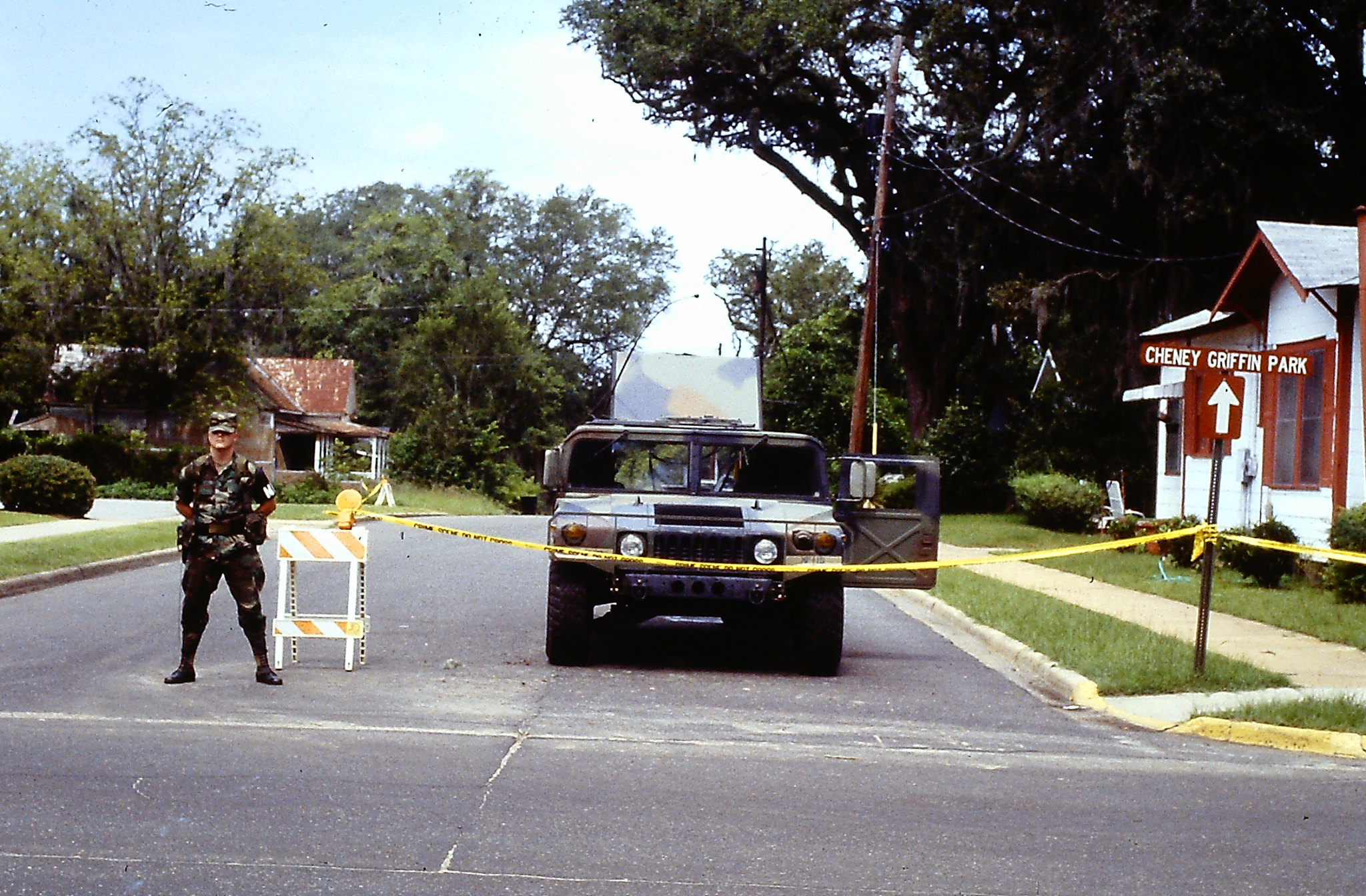
Military Police of the Georgia National Guard were activated multiple times from 1988 to 1990 to provide security for demonstrations
in Forsyth and Atlanta. Georgia National Guard Archives.

Annual training at Fort Stewart in 1986 provided the first exposure of the 178th MP Company to the Multiple Integrated Laser Engagement System.[15] Later that year, Soldiers of the 178th were part of an effort to ensure public safety for marchers in Forsyth County. In 1988, military police were put on standby to augment security at the Democrat convention in Atlanta. Then, in 1990, the 178th  joined hundreds of Georgia Guard Soldiers in providing security during tense demonstrations in which white supremacists and civil rights advocates faced off at the state capitol and Martin Luther King Center in Atlanta.[16] Despite escalating tensions, the demonstrations ended peacefully.


Twenty volunteers from the 178th MP Company mobilized with the 190th MP Company in September 1990 as part of Operation Desert Shield.[17] The MPs were among the first Georgia Guardsmen deployed overseas where they were stationed in Saudi Arabia.


Throughout its existence, the 178th MP Company has been recognized for collective and individual achievement. Captain Timothy Britt, commander of the 178th MP Company, was the 1991 recipient of the William Few Award,[18] and in 1992, Sgt. Andy Koundourakis of the 178th was the Georgia National Guard noncommissioned officer of the year.[19] Koundourakis followed up this feat in 1994 by achieving a new Winston P. Wilson Match record for assembly and disassembly of the M-60 machine gun during the competition at Little Rock, Ark. Koundourakis broke the record with a time of 3:34 while blindfolded.[20]


First Sgt. Clifford Peters, 178th MP Company was the 1991 recipient of the Ernest Vandiver Trophy. Georgia Guardsman Magazine.

In July 1994, Tropical Storm Alberto caused widespread flooding across south Georgia. The 178th MP Company was dispatched to Bainbridge, Ga. where floodwaters crested July 15. Two days later, the 178th redeployed to assist the people of Albany. Throughout their mission, the MPs stood 12 hour shifts in 90-degree heat and humidity.[21]


BAINBRIDGE, Ga. July, 1994 -  Military Police of the Monroe, Ga.-based 178th MP Company assisted law enforcement in Bainbridge with security
and traffic control following Tropical Storm Alberto. Georgia National Guard Archives.

During the 1996 Olympic Games in Atlanta, the 178th, along with the 190th MP Company and Company H, 121st LRS constituted Team Hotel, the task force charged with security of the Olympic Village. Assisting civil law enforcement, Team Hotel ensured the safety of more than 15,000 athletes and their family members.[22]


The 178th MP Company with 182 personnel was ordered to active federal service in support of Operation Noble Eagle February 11, 2002.[23] The 178th provided MP support to Guantanamo Bay Naval Base and augmented security at installations in Georgia. The 178th was released from active-duty December 17, 2002[24] but was again ordered to active federal service February 23, 2003,[25] for 12-month deployment in support of ONE.[26]


On Nov 19, 2008, the 178th MP Co was ordered to active federal service in support of Operation Iraqi Freedom. The unit returned home and was released from federal service December 23, 2009.


2011 was a busy year for the 178th. In January, the 178th assisted stranded motorists following winter storms.[27] The 178th fielded the M-1117 Armored Security Vehicle[28] and in June, Monroe MPs conducted an overseas training event in Haiti to provide humanitarian assistance.


SAVANNAH, Ga., Oct. 8, 2016-Georgia Guardsmen of the Monroe-based 178th Military Police Company are moving to assist first responders
and citizens of Savannah, Ga. following Hurricane Matthew. Photo by Staff Sgt. Michael Perry.

The 178th would again be called to assist following Winter Storms Pax and Leon in 2014 and provided personnel and equipment in response to hurricanes Matthew Irma, Michael and Dorian. Personnel of the 178th mobilized to the Country of Georgia for Exercise Agile Spirit 19 in the summer of 2019.

Georgia Army National Guardsmen with the Monroe-based 178th Military Police Company open
Agile Spirit 19 at Vaziani Training Area on July 27, 2019. Photo by Spc. Isaiah Matthews.


In March 2020, MPs from Monroe were among the first Georgia Guardsmen called to active duty in support of Georgia’s response to the COVID-19 pandemic. From May 2020 through 2021, the 178th MP Company supported law enforcement officials and augmented security at key response to civil demonstrations, the contested 2020 election and subsequent presidential inauguration.


A Georgia National Guard Soldier of the Monroe-based 178th Military Police Company observes a protest in Atlanta May 30, 2020.
Photo by Maj. William Carraway

Soldiers of the 178th mobilized with the 170th Military Police Battalion to sites in Atlanta January 27, 2023 to support civil authorities and protect citizens and property after Governor Brian Kemp declared a state of emergency in response to threats of violence against the city of Atlanta. Later that year, Soldiers of the 178th Military Police Company mobilized overseas in support of missions in the Central Command area of operations.

Soldiers of the 178th MP Company stand in formation during a 2023 departure ceremony in their hometown of Monroe, Ga.
Photo by Maj. William Carraway. 


[1] Official Register of the National Guard of Georgia for 1917. (Atlanta: Jan. 1, 1917) 88.


[3] Robert G. Burton to Mrs. P. F. Burton Oct. 18, 1918.


[4] Military Department, State of Georgia, “General Order No. 14.” September 27, 1939.


[5] Military Department, State of Georgia. Pictorial Review of the National Guard of the State of Georgia. (Atlanta: 1939), 56-57.


[6] The Center for Military History. “Lineage and Honors, 178th Military Police Company.”


[7] NG AROTO 325.4 April 12, 1956.


[8] RA 73-59 June 10, 1959.


[9] RA 57-63 March 21, 1963.


[10] RA 71-67 December 14, 1967.

[12] “Major General George J. Hearn Honored in Naming of Armory in Monroe Dedicated by Governor.” The Georgia Guardsman. September December 1968, 2.


[13] “Army and Air Guardsmen Support American Legion Parade.” The Georgia Guardsman. July December 1969, 14.

[14] “State Park Site No Picnic for 178th MP Co.” The Georgia Guardsman. January March 1970. 11.


[15] “Going MILES at AT.” The Georgia Guardsman. August September 1986, 11.

[16] “Guard Defends Rights Twice in 1990. The Georgia Guardsman. Spring 1990, 1.


[17] “Guardsman’s Letters Describe Desert Duty.” The Georgia Guardsman. Winter 1990, 15.


[18] “Awards and Honors.” The Georgia Guardsman. Fall 1991, 16.


[19] Mattie Jones. “178th has Georgia’s Top NCO.” The Georgia Guardsman. June 1992, 23.


[20] Eric Johnson“178th MP Breaks Record.” The Georgia Guardsman. March 1994, 16.


[21] “The Flood of 94.” The Georgia Guardsman. September 1994, 5

[22] Fred Baker and Thomas Meeks. “Locked and Loaded. Team Hotel Protects Olympic Athletes.” The Georgia Guardsman. Summer 1996, 19.


[23] DA PO 35-9.


[24] DA PO 345-1.


[25] DA PO 48-12.


[26] DA PO 68-23.


[27] “Patriot Winter 2011.” The Georgia Guardsman. January 2011, 3-4.


[28] Roy Henry. “Christmas Comes Early for MPs.” The Georgia Guardsman. June 2010, 2-3.

Blog Archive