Tuesday, May 28, 2024

History of Headquarters Company, 878th Engineer Battalion

By Major William Carraway

Historian, Georgia Army National Guard


Left: The distinctive unit insignia of the 878th Engineer Battalion. Right: Georgia Army National Guard Soldiers of the 878th Engineer Battalion
return from Afghanistan to their home Armory in Augusta Nov. 23, 2013. Photo by Maj. Will Cox.


The 878th Engineer Battalion was organized and federally recognized May 28, 1968; however, the Richmond Hussars, whose lineage is perpetuated by Headquarters Company of the 878th, has a much longer history.


Early History[1]

 On December 16, 1786, a troop of horse, designated the Augusta Dragoons, was organized at Augusta and attached to the 1st Battalion, 2nd Regiment, Georgia Militia. This troop was reorganized in June 1819 as the Richmond Hussars and attached to the 10th Regiment, Georgia Militia. In February, 1836, the Richmond Hussars entered federal service as infantry for service in the Second Creek War where they participated in the Florida Campaign.

On March 3, 1856, the Independent Volunteer Battalion of Augusta was formed to consist of six volunteer companies, including the Clinch Rifles, Oglethorpe Rifles, and Richmond Hussars. During the American Civil War, the Hussars served as Company A and Company I of Cobb’s Legion. The Hussars served in many of the major engagements of the eastern theater and earned campaign credit for Virginia 1861, the Peninsula, Sharpsburg, Fredericksburg, Gettysburg, Wilderness, and North Carolina 1865 before surrendering at Greensboro, N.C. April 26, 1865.[2]


In 1873, the Richmond Hussars were reborn as a unit of the Georgia State Troops and served until 1891 when they were redesignated as Troop A, 1st Battalion Cavalry. This unit was subsequently redesignated Troop K of the 1st Cavalry and served on the Mexican Border from 1916 to 1917 as Troop K, 2nd Squadron of Cavalry.[3]

The Georgia cavalry at Camp Cotton, El Paso, Texas in 1916. Photo by 2nd Lt. Vivian Roberts


The World Wars

 Returning from the border, the Troop was redesignated as Company C, 106th Field Signal Battalion, a unit of the 31st Division, and sent to Camp Wheeler for mobilization training. The 31st Division mobilized to France in October 1918, but was skeletonized upon arriving, and its units did not see active combat service. The Georgia Guard units of the 31st Division returned to the United States and were inactivated in 1919.

On October 2, 1939, the 214th Coast Artillery was constituted in the Georgia National Guard. Company A, 214th CA was organized in Augusta and carried forward the lineage of the Richmond Hussars. The 214th CA mobilized to Guadalcanal in 1943 and on October 11, 1943, the Richmond Hussars were redesignated as Company A, 528th Antiaircraft Artillery Gun Battalion. The company served in the Pacific Theater throughout the war earning campaign streamers for Guadalcanal, New Guinea, Northern Solomons and the Ryukyus. The unit returned to the United States and was released from active service in 1945.[4]


Post War Reorganization

Soldiers of the 250th AAA BN in 1953
Georgia National Guard Archives.
In 1947, the Richmond Hussars were reunited with the Clinch Rifles and Oglethorpe Rifles to form the 250th Antiaircraft Artillery Battalion, an element of the 108th Antiaircraft Artillery Brigade.[5] The Richmond Hussars, as Headquarters Battery, was federally recognized May 28, 1947. On August 14, 1950, just days after North Korean forces crossed into South Korea, more than 1,000 Georgia Guardsmen of the 108th AAA were activated for federal service[6]. Batteries of the 108th were stationed around cities and industrial areas from Wisconsin to Pennsylvania as a counter to possible Soviet missile and bombing attacks. The guns of the 108th AAA remained on station through the spring of 1952 before receiving the order to rotate home.

 In 1959, the 250th was inactivated and the Richmond Hussars became Headquarters Battery, 1st Gun Battalion, 214th Field Artillery.[7] In 1962, the unit was again reorganized as Headquarters Company, 5th Medium Tank Battalion, 108th Armor Regiment[8] and bore this distinction until 1968 when it received its present designation as Headquarters Company, 878th Engineer Battalion.[9] The 878th was assigned to the Atlanta Based 265th Engineer Group.[10]


Mobilizations and Deployments

In February 1973, more than 19 inches of snow fell over central Georgia. The 878th Engineer Battalion was called to state active duty to assist stranded motorists and clear roads.[11] In 1980, the 878th, then affiliated with the 92nd Engineer Battalion at Fort Stewart, constructed the Boy Scout summer camp in Augusta.[12]


Guardsmen of the 878th Engineer Battalion help clear the streets of Swainsboro February 10, 1973 following a record-breaking snowfall.
Georgia National Guard Archives.

In 1985, the 878th conducted annual training in Grenada where the engineers renovated and repaired schools on the island and trained citizens in construction techniques.[13] Personnel of the 878th deployed to Somalia in 1986 to survey a bridge project. Additional personnel travelled to Panama and participated in exercises Gallant Knight, Caber Dragon and Red Castle II.[14] The following year, personnel travelled to Jordan and Egypt for Exercise Bright Star.[15] In 1988, 878th personnel returned to Jordan and served as command and control for road construction projects in Amman.[16]

 In 1989, a reorganization of the 878th increased the headquarters company from 140 to 230 personnel. That same year, the 878th fielded the Small Unit Excavating Equipment (SEE) vehicle and mobilized to Somalia and Jordan.[17]

The 878th was mobilized in July 1994 following torrential rains of Tropical Storm Alberto that caused wide-spread flooding throughout South Georgia. The Engineers repaired washed out roads, cleared culverts, and removed debris.[18]


MONTEZUMA, Ga. July, 1994 - Soldiers of the Augusta-based 878th Engineer Battalion bulldoze fresh dirt over a washed-out road in response to
Tropical Storm Alberto. Photo by Spc. Chris Pearson.

In 1999, the 878th participated in Operation Caribbean Castle in the Dominican Republic. This operation involved more than 500 engineers who conducted three separate 15- day annual training periods from May to June. In the course of the mobilizations, the engineers constructed three schools which were desperately needed following the devastation on Hurricane Georges which struck the island in 1998.[19]

In the summer of 2002, the 878th Engineer Battalion was called upon to use its engineering expertise to demolish abandoned buildings that posed a health and safety risk in neighborhoods across the state as part of the governor’s counter drug efforts.[20] The 878th’s efforts took place in Atlanta, Swainsboro and Tallapoosa. The 878th would again partner with the Counter Drug Task Force and city of Atlanta for blighted building eradication in 2015.[21]

The 878th was ordered into active federal service April 1, 2003 at home stations for service during Operation Iraqi Freedom. As part of Task Force Baghdad, the 878th served for more than a year in and around the Iraqi capital before returning the state control August 3, 2004.[22] Subordinate units of the 878th Engineer Battalion were subsequently called to mobilize in support of overseas contingency operations.

In the summer of 2009, Soldiers of the 878th Engineer Battalion joined more than 650 service members from the Army, Navy and Marine Corps in humanitarian efforts in Guyana. The 878th constructed a new clinic to serve the people of Penitence, a suburb of Georgetown. Joining the Headquarters Company in the effort were Soldiers from the 876th Engineer Company and 175th Engineer Platoon. Soldiers of the battalion rotated into Guyana for 75 days for annual training.[23]

 In 2009, the 878th was assigned to the 648th Maneuver Enhancement Brigade. The 878th responded to south Georgia wildfires in the summer of 2011[25] and mobilized Soldiers to Hohenfels, Germany for annual training from May 19 to June 25, 2011.[26]
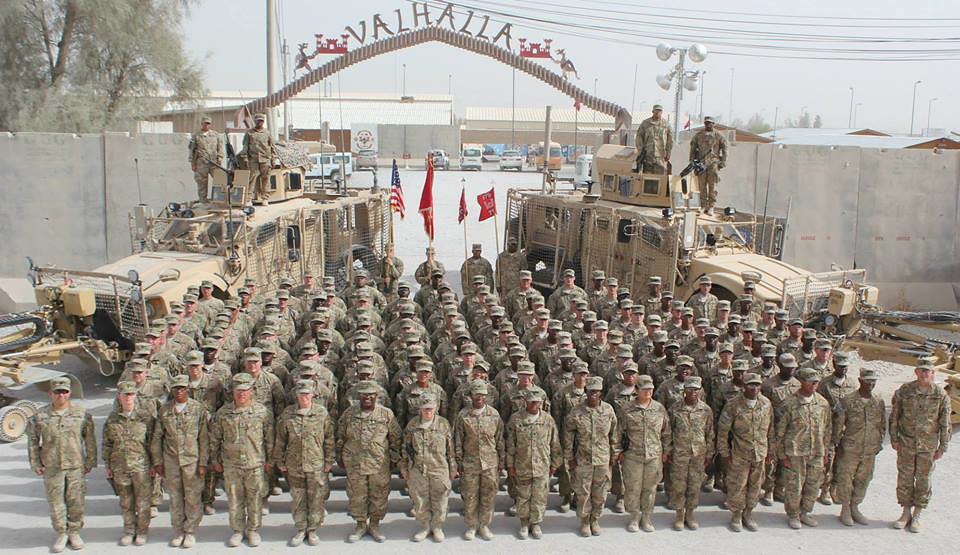
 

Georgia National Guard Soldiers from the 878th Task Force Dynamite stand in Afghanistan August 11, 2013. Georgia National Guard Archives.

The 878th mobilized to Afghanistan in March 2013[27] under the leadership of Lt. Col. Ed Granados and Command Sgt. Maj. Jeff Logan. The 878th, as Task Force Dynamite, trained Afghan National Army Soldiers in explosives identification and eradication.[28] The battalion returned in November 2013.

 Just months after returning from Afghanistan, Soldiers of the 878th were activated in the wake of winter storms that swept the state in January and February 2014. Later that year, Soldiers of the 878th traveled to the country of Georgia to the small mountain town of Sachkhere where they renovated a local school.[29]


AUGUSTA, Ga., Feb.14, 2014 –  Staff Sgt. Eric Horne, a fueler with the 878th Engineer Battalion refuels a truck at the 878th Augusta armory during
response operations to Winter Storm Pax. Photo by Sgt. Michael Uribe.

The Augusta engineers have been repeatedly called to assist civil authorities following hurricanes such as Joaquin, Irma, Michael and Dorian. The 878th participated in the state’s coordinated response to the COVID-19 pandemic and in 2021, mobilized personnel and equipment to Louisiana following Hurricane Ida.


Specialist Simeon George of the Augusta-based Headquarters and Headquarters Company, 878th Engineer Battalion directs traffic through
a vaccination site April 13, 2021, in Savannah, Georgia. Photo by Capt. Bryant Wine.

In addition to Headquarters Company and Company A, the 878th Engineer Battalion consists of the 177th Engineer Support Company, 848th Engineer Company, 863rd and 874th Engineer Utility Detachments, 877th Engineer Company and the newly constituted 876th Engineer Company. These engineer units themselves have a long history of overseas mobilizations and domestic operations which continues through 2024. 


[1] Gordon B. Smith. “Richmond Hussars.” January 28, 1978.


[2] Center for Military History, Lineage and Honors Certificate for the 878th Engineer Battalion


[3] Report of the Adjutant General, State of Georgia for the Year 1916. Atlanta, Ga.: Byrd Printing Company, 1917, 43.


[4] The Center for Military History. “Lineage and Honors of the 878th Engineer Battalion.”


[5] Military Department of the State of Georgia, GO 17. 31 December, 1946.


[7] RA 73-59, June 10, 1959.


[8] RA 47-62 April 16, 1962.


[9] RA 71-67 December 14, 1967.


[10] Annual Report, State of Georgia Department of Defense, 1968, Section IX.


[11] Carraway William, “45 Years Ago: Georgia National Guard Responds to 1973 Winter Storms.” Usarmy.mil, January 8, 2018. https://www.army.mil/article/198866/45_years_ago_georgia_national_guard_responds_to_1973_winter_storms#:~:text=In%2036%20hours%20of%20winter,one%20of%20those%20citizens%20rescued.


[12] Annual Report, State of Georgia Department of Defense, 1980, 15.


[13] Annual Report, State of Georgia Department of Defense, 1985, 4.


[14] Annual Report, State of Georgia Department of Defense, 1986, 5.


[15]Annual Report, State of Georgia Department of Defense, 1987, 3.


[16] Annual Report, State of Georgia Department of Defense, 1988, 2.


[17] Annual Report, State of Georgia Department of Defense, 1989, 4.

[18] Georgia Guardsman Magazine. September, 1994.


[19] Annual Report, State of Georgia Department of Defense, 1999, 10.


[20] Roy Henry/ “Another Crack house.” The Georgia Guardsman. Fall 2002, 14-15.


[21] “William Carraway. “CDTF Assists City of Atlanta.” The Georgia Guardsman. September 2015, 19.

[22] The Center for Military History. “Lineage and Honors of the 878th Engineer Battalion.”


[23] Roy Henry. “Georgia Engineers in Guyana for Humanitarian Operation.” The Georgia Guardsman. Vol . No. 6, 10.

 [25] Roy Henry. “National Guard Called to Assist with South Georgia Wildfires.” The Georgia Guardsman. July 2011, 17

[26] Alexander Grant. “Guard Engineers Conduct Annual Training in Southeast Germany.” The Georgia Guardsman. August 2011, 3-4.


[27] Roy Henry. “Augusta to Guardsmen. ‘Til We Meet Again.’” The Georgia Guardsman. March 2013, 7.

[28] Michael Bignardi. 78th Demolition Operations Training. The Georgia Guardsman. May 2013, 4.


[29] Sean McCulley. “SPP Building for Brighter Futures.” The Georgia Guardsman. November 2014, 5-6. 

Thursday, October 13, 2022

A History of Battery C, 1st Battalion 214th Field Artillery Regiment

By Maj. William Carraway, Historian, Georgia Army National Guard


Left: Members of Waynesboro’s Battery D, 101st AAA Battalion disassemble a 90-millimeter antiaircraft artillery gun at Camp Stewart
where they are undergoing two weeks of field training in July 1949. Right: Flames erupt from the muzzle of a Georgia Army National Guard
howitzer of Battery C, 1-214th Field Artillery during live-fire training at Fort Stewart in March, 2016. Photo by Capt. William Carraway

Early History

Battery C was originally organized February 5, 1890 as the Burke Light Infantry.[1] On July 5, 1916, the unit, then serving as Company E, 1st Georgia Infantry Regiment, was mobilized to the Mexican Border. The company served in El Paso, Texas before returning to Georgia in April 1917. Remaining in federal service, the company was redesignated Headquarters Battery, 118th Field Artillery Regiment September 23, 1917 and on October 1 was redesignated Battery C, 118th FA.[2] The unit mobilized to France with the 31st Infantry Division in October 1918 but arrived too late to take an active part in combat operations during World War I.

CAMP WHEELER, Macon, Ga. February 21, 1918 – Members of the 118th Field Artillery Regiment conduct “Butts Manual Drill” (rifle PT)
at Camp Wheeler. Photo 5485, National Archives Records Administration (NARA), College Park, Md.


The battery was reorganized in Waynesboro June 18, 1924 as Battery A, 118th Field Artillery Regiment, a unit of the 30th Division.[3] On December 1, 1934, the 118th was converted from horse-drawn artillery unit and received trucks for its towed 75mm howitzers.[4] In 1939, on the eve of World War I, the unit’s command team consisted of Capt. William J. Hatcher and 1st Sgt. Wister Black.


World War II

Ordered into federal service September 16, 1940, Battery A mobilized to Fort Jackson, S.C. for initial training with other units of the 30th Infantry Division. In June, the 30th ID mobilized for the Tennessee Maneuvers which put the Soldiers of the 118th in the field training until August 1941 when they returned to Fort Jackson.[5] That fall, the 118th departed for the Carolina Maneuvers, a massive training exercise conducted in North and South Carolina. During the maneuvers, the 30th Infantry Division was part of the I Corps, First Army.[6]

At the conclusion of the maneuvers, the 118th returned to Fort Jackson and in the summer of 1942 traded its 75 mm guns for 105 mm towed howitzers. In October the 118th traveled to Camp Blanding Fla., where it conducted training with the new weapons systems through May 1943. A training stint at Camp Gordon followed after which the battalion mobilized to Camp Tick, Tenn., where the battalion tackled field problems and maneuvers. This training rotation ran through November 1943 when the 118th was dispatched to Camp Atterbury, Indiana. Here, the battalion honed its expertise with the howitzer in preparation for deployment to the European Theater. In February 1944 the battalion was transported by rail to Camp Miles Standish, Mass. From there, the 118th set sail for England on the John T. Erickson on February 12, 1944.[7]

The 118th was in camp in England on June 6, 1944 when Operation Overlord was launched. Six days later, the 118th left camp just after 3:00 in the morning and arrived 12-hours later at a marshaling point near Dorchester.[8] Battery C loaded onto Landing Ship Tank 30 along with Headquarters Battery for transport to the continent and arrived the next day.

The 1st Battalion 118th Field Artillery Regiment unloads equipment on Omaha Beach June 13, 1944.


On June 13, 1944, the first elements of the 118th Field Artillery Battalion went ashore on Omaha Beach. Reaching a position near Neuilly, France, the Soldiers of the 118th established their first firing positions in an orchard outside of town. Three days later, an observation post overlooking the Vire Et Taute Canal called in a fire mission which was routed to one of the howitzers of Battery C. Thus, on the afternoon of June 16, 1944, with the pull of lanyard cord, Battery C fired the first round of the war for the 118th. Battery C and the 118th Field Artillery served with the 30th Division from France to Germany earning four Meritorious Unit Commendations. For their actions at the Battle of Mortain, the 118th received the Presidential Unit Citation.

Post War Reorganization and the Korean War

BG Paul Stone January 1963

Following the post-World War II reorganization of the Georgia National Guard, The former Battery C, 118th FA was reestablished in Waynesboro as Battery D, 101st Anti-Aircraft Artillery Battalion assigned to the Winder-based 108th Antiaircraft Artillery Brigade. The 101st was called to active federal service on August 14, 1950 with other units of the 108th AAA.[9] With a combined strength of just over 1,000 men, the 108th was dispatched to Fort Bliss Texas and assigned to the 8th U.S. Army. In November 1951, the 108th was dispatched to the Midwest and the 101st was garrisoned at Camp McCoy, Wisconsin. From there, the batteries of the 101st were assigned to protect the skies over cities and industrial centers of the Midwest with Battery D protecting the skies over Chicago.

The Waynesboro Battery remained in position through April 1952 with Capt. Paul Stone in command. After demobilizing at Camp McCoy, the 101st returned home. Over the next seven years, the Waynseboro battery earned six consecutive superior ratings and Stone received the Georgia Distinctive Service Medal and promotion to major.[10] After a brief tenure on the staff of the 108th AAA, Stone transferred to the Georgia Air National Guard. He retired in 1971 as a brigadier general having served eight years as commander of the Ga. ANG.[11]


The Berlin Crisis

On July 1, 1959 Battery D was reorganized as Company B, 111th Signal Battalion.[12] Later that year, Company B became the first unit of the Georgia National Guard to receive a live video broadcast which was sent from Fort Gordon, Ga.[13] The battalion conducted annual training at Fort Gordon June 26-July 10 1960 and July 16-30, 1961.

FORT GORDON, Ga. November 30, 1959 - Major General George Hearn, Georgia's Adjutant General, and Brig. Gen. David P. Gibbs,
commanding general of the Signal Training Center conduct the first live telecast sent to National Guardsmen during training.
More than two hours of live and video taped messages were transmitted from Fort Gordon to the Waynesboro, Ga. Armory of Company B,
 111th Signal Battalion. Georgia National Guard Archives.


In August 1961, after months of tension between the United States and Soviet Union the Soviets blocked the lines of communication into Berlin, isolating the city and began construction of the Berlin Wall. In response, President Kennedy activated 156,000 Guard and Reservists and dispatched two additional Army divisions to Europe. While several units of the Georgia National Guard were placed on alert the 111th Signal Battalion was the only one called to active federal service. The 111th reported for active-duty October 15th and departed by train for Fort Meade, Md. October 25th.[14]

Guardsmen of Waynesboro-based Company B 111th Signal Battalion. Georgia National Guard Archives.


Arriving at Fort Meade the next day, the 111th replaced an active-duty signal battalion which had been mobilized to Europe. Within 24 hours, the Berlin Crisis reached new heights as U.S. and Soviet tanks faced each other with live ammunition at Checkpoint Charlie, a crossing point between East and West Berlin. Ultimately, Kennedy and Khruschev, speaking through intermediaries, agreed to deescalate the situation and the tanks were withdrawn.

Unaware of how close the United States had come to the brink of war, the 111th settled into their new environment at Fort Meade. In addition to their regular duties, the 111th trained aggressively for possible deployment, conducted field problems and became more proficient in switchboard operation and the emerging technology of television.

In May, 1962, the 111th Signal Battalion participated in Operation Wet Horse II, a U.S. Army amphibious assault exercise designed to test the capability of reserve units to conduct large-scale landing operations. Cameras of the 111th Signal Battalion covered the operation as tanks of the 150th Armored Cavalry Regiment drove ashore from landing craft piloted by the U.S. Army Reserve’s 231st Transportation Company. Images of these landings were prominently featured in U.S. and European newspapers and conveyed the resolve of the United States’ position in Berlin.

FORT MILES, Del., May, 1962 - A jeep with a trailer slashes through the surf as it disembarks from an Army landing craft at Fort Miles during
Exercise Wet Horse II. It will be followed by an M-48 Patton tank.  Photo by Georgia Army National Guard, 111th Signal Battalion, Photo Platoon.
  Image courtesy of National Guard Educational Foundation, Washington, D.C.


On August 9, 1962, their mission complete, the Georgia Guardsmen of the 111th Signal Battalion boarded charter aircraft for the flight home. Landing at Bush Field in Augusta, the 111th received a hero’s welcome. Major Gen. Hearn greeted each Guardsman as they departed the aircraft then read a special citation from Governor Ernest Vandiver commending the Soldiers for their” loyalty and sacrifices made in the national interest.”[15]

Reorganization, the 48th AD and Return to Artillery Mission

The 1963 reorganization of the Georgia Army National Guard prompted the conversion of Company B to form Company C, 3rd Battalion, 121st Infantry Regiment.[16] The conversion brought the company under the 48th Armor Division. This command relationship held through the December 1967 inactivation of the 48th AD whereupon the unit was converted to its present designation, Battery C, 214th FA, and equipped with self-propelled 155mm howitzers.[17]

Soldiers of Battery C were among the 500 Georgia Guardsmen activated in response to the winter snowstorm of February 10-11, 1973. The Waynesboro Guardsmen responded to more than 200 calls for assistance and delivered 18 stranded motorists to the Waynesboro Armory for shelter where they provided them blankets, lodging and meals.[18]

FORT STEWART, Ga. July 1974 - Georgia National Guard Soldiers of Battery C, 1st Battalion 214th Artillery of Waynesboro, Ga. receive a briefing
before a firing mission at annual training at Fort Stewart, Ga. Georgia National Guard Archives.


The Waynesboro Battery mobilized to Norway for annual training as part of the NATO Composite Force in 1992, 1994 and 1996.[19] Operating more than 300 miles north of the Arctic Circle, the artillerymen of the 1-214th trained in a region that had previously been the target of Russian invasion. Within weeks of their return from Norway in 1994, the Waynesboro Guardsmen were deployed in response to Tropical Storm Alberto which caused widespread flooding in South Georgia in July 1994.

In 1998 the 214th received the M-109A6 Paladin, the most advanced self-propelled howitzer in the Army inventory. The Paladins replaced the older model M109A3 Howitzers.[20]

The War on Terror to Present

ATLANTA, April 26, 2014 - Specialist Jonathan Mathews of Battery C, 1-214th Field Artillery is honored by Governor Nathan Deal during
a ceremony following the return of the unit from Afghanistan. Georgia National Guard archives.


The 214th was activated March 20, 2003 for service in Iraq. After arriving at Fort Bragg the battalion’s mission was changed to support Operation Noble Eagle which encompassed state-side security operations. Soldiers of Battery C were among the nearly 500 Soldiers mobilized and were the last to return from mobilization in January 2004.[21]

Battery C mobilized to Iraq in June 2007 following a train up at Fort Bliss and assumed the detainee security mission at Camp Bucca. The unit returned to Georgia June 2, 2008.[22]  

In 2013, the 1-214th again mobilized overseas to provide base defense operations in western Afghanistan. As part of the mission the 1-214th secured entry control points, provided flight line security and patrolled an area of 315 square kilometers.[23]

FORT STEWART, Ga. March 16, 2016 – Battery C, 1-214th Field Artillery conducting live-fire training. Photo by Capt. William Carraway.

In 2020, Battery C relocated from Waynesboro to Ellenwood.[24] The following year the unit added to its long history over overseas mobilizations with personnel and howitzers participating in Exercise African Lion in Morocco in June 2021.


The guidon of the Ellenwood-based Battery C, 1st Battalion, 214th Field Artillery, 648th Maneuver Enhancement Brigade, stands at the ready during
M109A6 Paladin howitzer training during African Lion 2021 at Cap Draa, Morocco, June 16, 2021. Photo by Sgt. Nathan Baker.


The battery guidon of the Ellenwood-based Charlie Battery, 1st Battalion, 214th Field Artillery, 648th Maneuver Enhancement Brigade, Georgia Army National Guard, stands at the ready during M109A6 Paladin howitzer training during African Lion 2021 at Cap Draa, Morocco, June 16, 2021. Photo by Sgt. Nathan Baker.


[1] Annual Report of the Adjutant General of the State of Georgia and Official Register of the National Guard for the Year 1920. (Atlanta: Chas. P. Byrd) 169.

[2] Annual Report of the Adjutant General of the State of Georgia and Official Register of the National Guard for the Year 1920. (Atlanta: Chas. P. Byrd) 169.

[3] Center for Military History. “Roster, Federally Recognized National Guard Units. (Parts 1 and 2) 1917.” Unpublished manuscript, 1925, typescript.

[4] Center for Military History. “Form 3-10955 Battery A 118th FA (typescript)”

[5] Gordon Burns Smith. History in Action: 118th Field Artillery, 30th Infantry Division 1942-1945, 2nd Edition. (Washington, D.C.: Florida “Gator” Chapter, 1988) 8.

[6] Christopher R. Gabel. The U.S. Army GHQ Maneuvers of 1941. (Washington, D.C: Center of Military History, U.S. Army, 1992) 200.

[7] Gordon Burns Smith. History in Action: 118th Field Artillery, 30th Infantry Division 1942-1945, 2nd Edition. (Washington, D.C.: Florida “Gator” Chapter, 1988) 19.

[8] Gordon Burns Smith. History in Action: 118th Field Artillery, 30th Infantry Division 1942-1945, 2nd Edition. (Washington, D.C.: Florida “Gator” Chapter, 1988) 33.

[9] Renee Hylton. Where Are We Going: The National Guard and the Korean War 1950-1953, 51.

[10] “Brig. Gen. Paul S. Stone Becomes Asst. Adj. Gen. for Air.” Georgia Guardsman, January 1963, 5.

[11] “Retirements.” Georgia Guardsman, May 1974, 20.

[12] RA 73-59 June 10, 1959 effective July 1, 1959.

[13] “Closed-Circuit Telecasts Beamed to 111th Sig BN.” Georgia Guardsman, Oct-Nov-Dec 1959, 8.

[14] “President Mobilizes Georgia Guard’s 111th Signal Battalion.” Georgia Guardsman. Oct, Nov, Dec 1961, 4-5.

[15] “Signal Battalion Returns to Georgia After Ft. Meade Duty.” Georgia Guardsman, July-August 1962, 8-9.

[16] RA 57-63 March 21, 1963 effective April 16, 1963.

[17] RA 71-67 December 14, 1967 effective January 1, 1968.

[18] “Guardsmen Rescue Georgians and Travelers.” Georgia Guardsman, March April 1973, 2-4.

[19] “Ga. Guard Spans Globe for Annual Training.” Georgia Guardsman, March 1993, 5.

[20] Building for the New Century: The Georgia Department of Defense in 1998. (Atlanta: 1998) 7.

[21] First Friday Briefing, February 7, 2004.

[22] First Friday Briefing, June 2008, 1 and 15.

[23] Jasmine Jacobs. “Welcome Home Granite Battalion. Georgia Guardsman, January 2014, 3.

[24] OA 133-20 September 29, 2020 effective May 25, 2020.


Blog Archive