Friday, March 3, 2023

Georgia National Guard's Georgia Military Institute Explores Military History Through Staff Ride

 By Maj. William Carraway, Historian, Georgia National Guard

Collage: The Georgia Military Institute shoulder Sleeve Insignia of Class 1 and officer candidates of Class 62.


Officer candidates of the Georgia Army National Guard’s Georgia Military Institute conducted a staff ride March 3, 2023 at the Atlanta History Center. The staff ride is part of the long tradition of military history education in the GMI leadership curriculum.

Officer Candidates of GMI Class 62 conduct a sand table brief on the Battle of Kennesaw Mountain January 7, 2023 in preparation for the March
staff ride in Atlanta. Photo by Maj. William Carraway.


For two months prior to the staff ride, the officer candidates researched the Atlanta Campaign and the Battle of Kennesaw Mountain. Assuming the roles of staff and commanders for the Federal and Confederate forces, the candidates conducted sand table briefs covering operational and terrain considerations and evaluating courses of actions for commanders on both sides of the conflict. Major William Carraway, Historian of the Georgia National Guard and graduate of GMI Class 46, presided over the briefings linking the events with the principles of war and modern military tactics. These principles and tactics will be the focus of training for the officer candidates as they begin phase three of training in the field in April.


Drew Hathaway recounts the evolution of military history training at GMI. Photo by Maj. William Carraway

Retired Captain Drew Hathaway opened the staff ride at the Atlanta History Center with an overview of the evolution of military history education at GMI over the years. A graduate of GMI Class 49, Hathaway was part of the first class to train fully at the Clay National Guard Center after GMI relocated there from Macon.


Historian Michael Hitt covers the antebellum to Civil War history of the Georgia Military Institute. Photo by Maj. William Carraway.

Historian Michael Hitt, dressed in the antebellum uniform of a GMI instructor, addressed the officer candidates on the history of GMI beginning with the first period which ran from the opening of the institute in 1851 through the destruction of the campus in 1864 and the surrender of the cadet battalion in 1865. Hitt next recalled the brief period beginning in 1891 when GMI was resurrected with campus buildings in Atlanta. This heretofore little known period of GMI history had not appeared in printed history of the institute and represents an emerging field of study for the history of the Georgia National Guard.  Ultimately, the second iteration of GMI ended in 1898 with the auction of campus buildings and land which would form part of the Woodward Academy in College Park. 

This building served as part of the Georgia Military Institute in Atlanta from 1891-1898. Photo by Maj. William Carraway. 


While the campus might have closed, the legacy of this iteration of GMI continued forward as graduates served during the Spanish American War, on the Mexican Border in 1916 and through World War I.
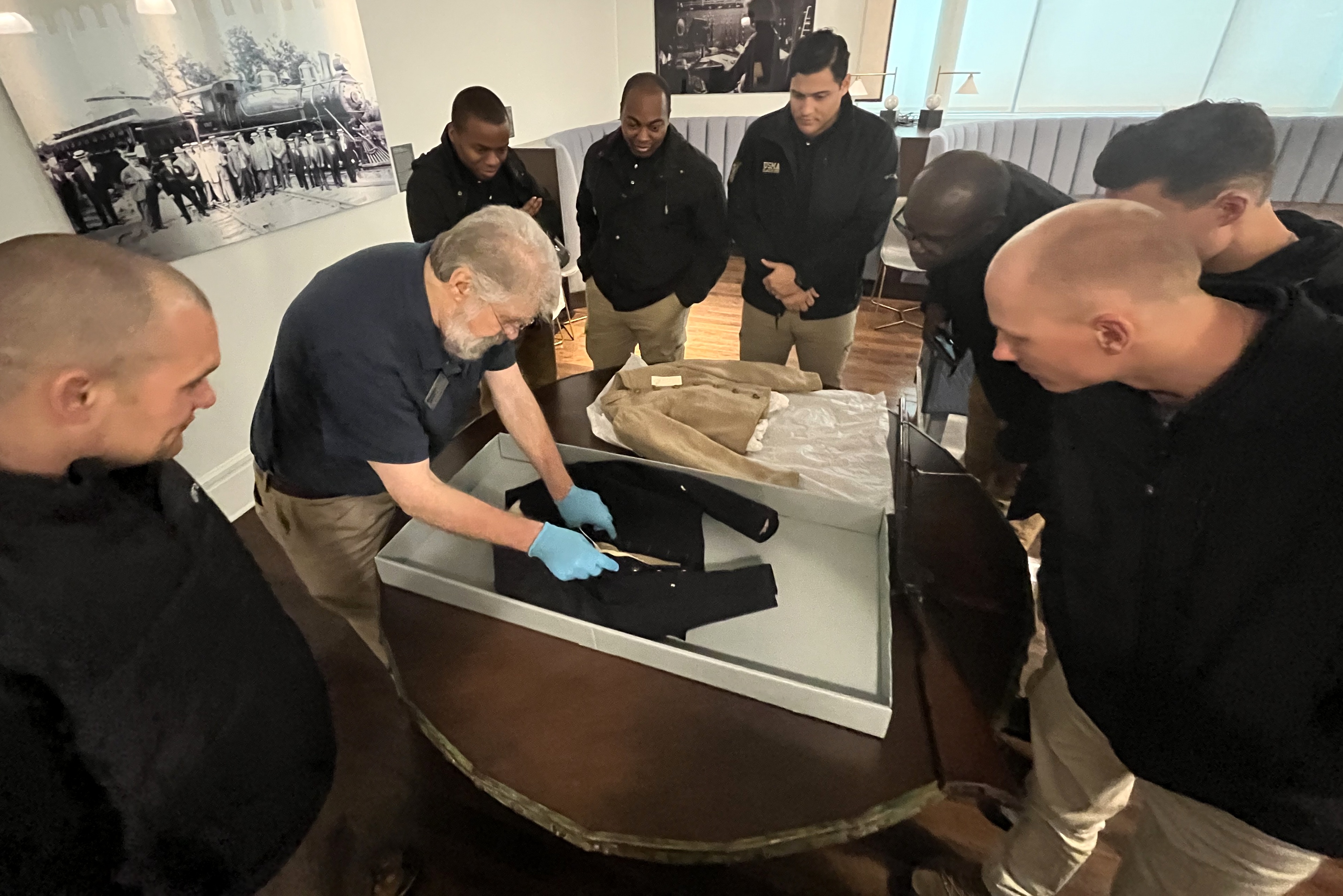
 

Doctor Gordon Jones, senior military historian of the Atlanta History Center provides officer candidates of GMI Class 62 with a close view of
artifacts relevant to the institute’s history. Photo by Maj. William Carraway.

Doctor Gordon Jones, senior military historian of the Atlanta History Center provided the officer candidates with a close view of artifacts relevant to the institute’s history. The candidates viewed Cadet John M. Hazlehurst cadet uniform worn while attending the Georgia Military Institute as well as his field jacket from his service in the Cadet Battalion from 1864-1865. Additionally, Dr. Jones and Michael Hitt demonstrated civil war weapons used by and against the Cadet Battalion during their service in the American Civil War. Among these weapons was the Spencer Repeating Rifle which was employed by the 9th Illinois Mounted Infantry against the Cadet Battalion in skirmishes before the Battle of Resaca in May 1864.


Officer Candidates of GMI Class 1 March in formation at their armory in Forsyth in 1961. Georgia National Guard Archives.

While the staff ride was rich in military history and lessons of prior conflicts, the officer candidates were also immersed in the history of the Georgia Military Institute. The current GMI was authorized in 1961 by Governor Ernest Vandiver and was based in Forsyth, the present location of Headquarters Company, 2nd Battalion, 121st Infantry Regiment. In October 1967, GMI relocated to Milledgeville and occupied the Carl Vinson Training Center. It would remain in Milledgeville until February 1985 when the institute relocated to Macon. From its Macon location, GMI conducted field training in wooded terrain in nearby Griswoldville. The institute moved to its present location in 2009 where GMI Class 48 became the first class to graduate at the Clay National Guard Center.


This collage represents 24 years of GMI history. Top left: Class 23 conducts PT in Milledgeville. Top Right: Class 29 rappelling. 
Bottom left: Class 46 conducts field training at Griswoldville. Bottom right: GMI in Macon in 2007. 

Since GMI Class 1 graduated in 1962, the institute has commissioned 1,217 second lieutenants in the Georgia Army National Guard. These officers have served in all of America’s wars beginning with Vietnam and continuing through ongoing conflicts overseas. Georgia Military Institute graduates were part of the 48th Infantry Brigade’s deployment to Bosnia Herzegovina and deployed to Iraq and Afghanistan. From Class 1 to the present class 62, GMI graduates have risen to the highest ranks of the Georgia National Guard including the office of adjutant general while others have gone on to joint commands in the U.S. Army as general officers.

The Georgia Military Institute is assigned to the 2nd Battalion, 122nd Regional Training Institute commanded by Lt. Col. Jeff Freeman, GMI Class 32. The 122nd RTI is commanded by Col. Theodore Scott, GMI Class 36. The Georgia Military Institute’s senior instructor is Capt. Joshua Merry, GMI, Class 55.


Friday, July 2, 2021

The Macon Volunteers at Gettysburg July 2, 1863

By Maj. William Carraway

Historian, Georgia Army National Guard


Note: This article is an excerpt of a history of the Macon Volunteers currently in progress.


Logo of the Macon Volunteers and Map of the Actions of Anderson's Division July 2, 1863 by Hal Jespersen

Gettysburg

In the reorganization of the Confederate Army of Northern Virginia following Chancellorsville, the Division of Brig. Gen. Robert H. Anderson was assigned to the newly created 3rd Corps under Lt. Gen. A. P. Hill. The Macon Volunteers, as part of the 2nd Georgia Battalion were assigned to the brigade of Brig. Gen. Ambrose Wright, Anderson’s Division.


Array of forces July 2, 1863. LOC

In support of Gen. Lee’s second attempt to take the war to the North, the Macon Volunteers took up the march on June 14 1863 and entered Pennsylvania on June 26.[1] Alerted to the presence of Federal forces at Gettysburg July 1, Anderson’s Division, then in Cashtown, marched to the battlefield and assembled on Herr Ridge by 5:00 that evening.[2]


On the morning of July 2, Hill ordered Anderson to advance and occupy positions on Seminary Ridge preparatory to an assault on Federal lines. The Confederate assault proceeded en echelon from the right as Longstreet’s 1st Corps initiated the assault with an artillery barrage at 2:00 pm. It would take more than three hours for the units to the right of Anderson’s Division to be committed.


With the advance of Maj. Gen. Lafayette McLaws immediately to his right, Anderson ordered his brigades forward.[3] Wright positioned his regiments with the 28th on the right adjacent to the 2nd Florida of Lang’s Brigade. The 3rd advanced in the center with the 48th Georgia to their left. Wright ordered the 2nd Georgia Battalion to advance forward of the brigade as skirmishers. Rushing forward, the battalion posted behind a split rail fence northwest of the Codori Farm and the Emmitsburg Road.[4] Two Federal regiments, the 82nd New York and 15th Massachusetts were on the opposite side of the road supported by the Battery B, 1st Rhode Island Artillery commanded by Capt. Thomas Brown.


The fence bordering the Emmitsburg Road behind which the Macon Volunteers formed on July 2, 1863. Photo by Maj. William Carraway

The Macon Volunteers and others of the battalion passed several tense minutes in their forward exposed position before Wright’s regiments reached them. Whereas the 2nd Battalion was supposed to fall into the marching order on the left of the 48th, Ga. its soldiers were disrupted as the brigade passed through its ranks and the Volunteers were compelled to fall in with the advancing regiments. Though undulating terrain and tall grass obscured their early advance, the Georgians were exposed to a galling fire from three brigades of infantry and three artillery batteries as they approached the Emmitsburg Road. Nevertheless, Wright’s advance was so swift that by the time Brown observed them he scarcely had time bring two of his sections to bear. Unleashing a devastating volley that sent “scores of Wright’s men sprawling in the grass,”[5] the New Yorkers realized with horror that Wright’s line, three regiment’s wide, would presently envelop their left flank. Reading the tactical situation, the veterans of the 82nd N.Y. began to withdraw and with them followed the 15th Mass. As its infantry support melted away, Brown’s battery was engulfed by the 48th Georgia which captured the guns and mortally wounded Brown. Seizing the opportunity afforded by the fleeing Federals, the 22nd and 3rd Georgia, supported by elements of the 2nd Battalion swiftly advanced as the Federal units to their front could not fire for fear of hitting their own men. Wright regarded this opportunity while casting fleeting glimpses to his left. Posey’s brigade had failed to match the advance of Wright’s Georgians leaving their left flank exposed. Into this flank 1st Lt. Alonzo Cushing’s Battery A, 4th U.S. Artillery, poured a murderous fire of grapeshot and cannister. In the maelstrom of combat, Capt. George S. Jones, commanding Macon Volunteers, was desperately wounded in the face, side and arm and collapsed to the ground. He was captured and sent to Johnson’s Island. Subsequently exchanged, Jones rejoined the Volunteers and fought on until the surrender at Appomattox Court House.[6]  

Command of the Macon Volunteers devolved to 1st Lt. Edward Grannis, but he scarce had time to execute command before he fell mortally wounded not far from his captain. He died the following day. Second Lieutenant Thomas Kennedy Campbell, the sole remaining officer of the Macon Volunteers was shot through the lower abdomen by cannister fire. He was captured, treated at a Federal field hospital, and dispatched to Fort McHenry, Md.[7]


The Codori Farm viewed from the position of Cushing's Battery. The Macon Volunteers passed over this ground July 2, 1863. Photo by William Carraway

Wright’s Georgians had penetrated the Federal line and advanced farther than any Confederate troops that day, farther indeed than any of the soldiers who would cross over the same fields the next day as part of Maj. Gen. George’s Pickett’s doomed charge. Nevertheless, surveying the murderous scene, Wright realized that his gains were unsustainable. Seething at the absence of support from adjacent units, Wright ordered his troops to withdraw to their pre-assault position on Seminary Ridge where they remained until called forward to help cover the retreat of Pickett’s shattered units the next day. On the evening of July 4, the 87th anniversary of the independence of the United States, Wright’s Brigade, and what remained of the Macon Volunteers quietly marched away From Gettysburg. Ten days later, they crossed the Potomac with half the men they had taken north just 19 days earlier.[8]


In his report on the Gettysburg Campaign, Wright bitterly lamented the sacrifice his troops had made for naught. He credited his troops with capturing 25 artillery pieces, noting that the 2nd Battalion had accounted for “as many as 5 or 6 pieces.”[9] The cannons came at a high price. Wright reported 688 killed or wounded and a casualty rate of nearly 51 percent. Three of Wright’s four regimental and battalion commanders fell including Maj. George Ross of the 2nd Battalion who was mortally wounded and captured at the crest of Cemetery Ridge.[10] The 2nd Battalion lost 82 out of 173 who went into action.[11]


Analysis of the Macon Volunteers service records finds that of an aggregate strength of 52, 16 were killed, wounded or captured including all the company’s officers. In a rear-guard action at Manassas Gap, July 23, 1863, the company lost five of its remaining 36 Solders to a superior Federal force.[12]


Postscript

On Aug. 4, 1864, more than one year after being shot through the bowels by cannister at Gettysburg, and long after other prisoners from Gettysburg had been exchanged, Lt. Thomas Campbell of the Macon Volunteers penned the following letter to Col. William Hoffman, commissary general of prisoners from his cell at Fort McHenry hospital:

Sir,

I have the honor to submit my care to you for your human consideration. I was wounded at the battle of Gettysburg July 2, 1863. Ball entering the left side of the bowel, passing through making its exit near the spinal column. I have been confined to the bed ever since... I feel quite sure from the condition I am in at this time that my stay upon the earth will be short. My only desire is to be permitted to return to my home and spend the few days left me in this life in the bosom of my family where their kind attention may soothe my journey to the grave. Hoping this application may meet with your approval and early considerations.

I am, colonel, your most obt. svt.


Thos. K Campbell

Lt. Co. B 2nd Ga Batt[13]


Lieutenant Campbell died from the effects of his wound Sept, 23, 1864 at Fort McHenry. He was 31 years old.

The headstone of 2nd Lt. Thomas K. Campbell in Rose Hill Cemetery, Macon, Ga. Photo by Jimmy Allen.


[4] Bradley M. Gottfried, The Maps of Gettysburg: An Atlas of the Gettysburg Campaign, June 3-July 13, 1863 (New York: Savas Beatie, 2010), 204-205.


[5] Bradley M. Gottfried, The Maps of Gettysburg: An Atlas of the Gettysburg Campaign, June 3-July 13, 1863, 206.

----

[6] National Archives Microfilm Publications Microcopy No. 266. Compiled Service Records of Confederate Soldiers Who Served in Organizations from the State of Georgia. The Second Battalion Infantry. Roll 159-162.

[7] National Archives Microfilm Publications Microcopy No. 266. Compiled Service Records of Confederate Soldiers Who Served in Organizations from the State of Georgia. The Second Battalion Infantry. Roll 159-162.


[8] U.S. War Department. The War of the Rebellion: A Compilation of the Official Records of the Union and Confederate Armies, 1 / v. 27, Part 2: Reports. 615.


[9] U.S. War Department. The War of the Rebellion: A Compilation of the Official Records of the Union and Confederate Armies, 1 / v. 27, Part 2: Reports. 624.


[10] U.S. War Department. The War of the Rebellion: A Compilation of the Official Records of the Union and Confederate Armies, 1 / v. 27, Part 2: Reports. 625.


[11] J. David. Petruzzi and Steven Stanley, The Gettysburg Campaign in Numbers and Losses: Synopses, Orders of Battle, Strengths, Casualties, and Maps, June 9-July 14, 1863 (El Dorado Hills, CA: Savas Beatie, 2013) 130.


[13] National Archives Microfilm Publications Microcopy No. 266. Compiled Service Records of Confederate Soldiers Who Served in Organizations from the State of Georgia. The Second Battalion Infantry. Thomas Campbell.

Monday, March 9, 2020

Georgia Military Institute Officer Candidates Experience Lessons of the Past During Civil War Staff Ride


By Major William Carraway
Historian, Georgia Army National Guard

Major William Carraway, historian of the Georgia Army National Guard, leads officer candidates of the Georgia Military Institute's Officer Candidate School Class 59 in recreating the charge of Col. Dan McCook's Federal brigade during a staff ride at the Kennesaw Mountain Battlefield March 6, 2020. Photo by Capt. Shannell Chappell.
Officer candidates of the Georgia Army National Guard’s Georgia Military Institute’s Officer Candidate School Class 59 conducted a staff ride at the Kennesaw Mountain National Battlefield in Kennesaw, Ga. March 6, 2020. The staff ride, which covered the actions of the Atlanta Campaign during the American Civil War was facilitated by Maj. William Carraway, historian of the Georgia Army National Guard.

Officer candidates of the Georgia Military Institute's OCS
Class 59 receive a block of instruction on Civil War rifle 
muskets from Maj. William Carraway, historian of the 
Georgia Army National Guard. Photo by Sgt. Elisel Jimenez.
The purpose of the Kennesaw Mountain Staff Ride was to draw parallels between combat in the American Civil War and implications to the modern battlefield. The future officers began the learning process for the staff ride months ago with reading assignments and research objectives designed to make them subject matter experts in a particular aspect of Civil War combat, such as artillery, small-arms, logistics, transportation, intelligence and terrain analysis. The officer candidates learned the strategic and operational objectives of the 1864 campaigns and applied principles of war in the analysis of courses of actions available to the Federal and Confederate commanders. Additionally, candidates considered how weather and logistical concerns factored into the decision-making process that resulted in the Battle of Kennesaw Mountain.

Following a sand table brief in which the candidates role-played Generals William Sherman, Joseph Johnston and their staffs, the candidates travelled to Kennesaw Mountain to observe the terrain considerations that confronted the contending armies. The candidates ascended to the top of Kennesaw Mountain and observed the direction of approach of the Federal Armies from the summit. From the top of the mountain, the candidates could survey the ground before them and understand how Confederate commanders had a clear picture of the Federal commander’s intent and maneuvers.

Returning to the base of the mountain, the candidates visited the ground that was held by Georgia troops and stood on the picket line that was held by the 63rd Georgia Infantry Regiment. The candidates experienced the nine steps required to fire an original civil war musket and practiced the loading process in an attempt to achieve a firing rate of three rounds per minute. To demonstrate the effective engagement distances of American Civil War battlefields, Carraway marched off the distance a Soldier could travel in the time it took a Soldier to load and fire a musket. He then told the candidates to reload, fixed a bayonet to the musket and charged their position to demonstrate the psychological impact of a massed charge.

Georgia Army National Guard Officer Candidates of the Georgia Military Institute's OCS Class 59 practice the nine steps required to fire a Civil War-era musket during a staff ride at the Kennesaw Mountain Battlefield March 6, 2020. Photo by Capt. Shannell Chappell.

The staff ride culminated with the candidates recreating the charge of Col. Dan McCook’s Federal brigade on Cheatham Hill. The candidates were put through crash-course of Civil War-era drill and practiced moving from a column of march to a line of battle. They then advanced from the Federal assembly position, through the woods, crossed two creeks and emerged at the base of Cheatham Hill where they beheld the objective before them. The candidates moved from a column to a line of battle and began the slow ascent of Cheatham Hill while Carraway called out musket volleys and artillery barrages that would have reaped gaps in their lines. Reaching what they thought was the crest of the hill, the candidates collapsed exhausted only to learn that the actual Confederate line was nearly 50 meters further.

As a result of their hands-on experience with Civil War weapons systems on the original battlefield, the officer candidates received invaluable exposure to historic combat conditions and the lessons that resonate for the modern battlefield. A key takeaway of the learning experience was that whether planning an extended campaign in 1864 or a 72-hour platoon operation in Afghanistan, there are similarities, and a study of military history is vital to the success of today’s military leader. 
Georgia Army National Guard Officer Candidates of the Georgia Military Institute's Officer Candidate School Class 59 stand at the Illinois Monument on Cheatham Hill after recreating the charge of Col. Dan McCook's Federal Brigade during a staff ride at the Kennesaw Mountain Battlefield March 6, 2020. Photo by Sgt. Elisel Jimenez.

Saturday, November 30, 2019

Franklin: The Death Angel Gathers Its Last Harvest

By Maj. William Carraway
Historian, Georgia Army National Guard

If you have participated in a staff ride at a Civil War battlefield, it is likely you learned of tactics employed, leadership tests and decisions made in the heat of conflict. A staff ride provides the opportunity to connect with leaders and great events of the past, to reveal the human dimension of war and to apply lessons of the past to present and future Army operations. One human dimension hitherto lacking in the staff ride experience, has been the roll of post-traumatic stress on the veterans of these great battles. We are left to assume that our generation is the only one to combat PTS, and yet, a study of Civil War letters reveals a connection between our experience and the experiences of the Civil War Soldier. It is critical that we make this connection, that our veterans know that they are not alone in their experiences. 


The Battle of Franklin Tennessee, fought on November 30, 1864, provides a study in the savagery of war and its lasting impact on those who return. Samuel Watkins, a private in the 1st Tennessee wrote of the Battle of Franklin:

“Kind reader, right here my pen, and courage, and ability fail me. I shrink from butchery. Would to God I could tear the page from these memoirs and from my own memory. It is the blackest page in the history of (the war). It was the bloodiest battle of modern times in any war…  I was there. I saw it. My flesh trembles, and creeps, and crawls when I think of it today. My heart almost ceases to beat at the horrid recollection. Would to God that I had never witnessed such a scene!”[1]

Writing in his memoir, Co. Aytch, nearly 20 years after the Battle of Franklin, Watkins reveals the difficulty in discussing the battle, an experience shared by Veterans of 21st century conflicts:

“I cannot describe it. It beggars description. I will not attempt to describe it. I could not. The death-angel was there to gather its last harvest. It was the grand coronation of death. Would that I could turn the page. But I feel, though I did so, that page would still be there, teeming with its scenes of horror and blood. I can only tell of what I saw.”[2]

 Situation

In the waning days of November 1864, the Confederate Army of Tennessee under Lt. Gen. John Bell Hood had pursued the smaller Federal army of Maj. Gen. John Schofield to the town of Franklin approximately 15 miles from Nashville, Tenn. Hood intended to isolate the Federal Army before it could reach the safety of Nashville and its Federal garrison.

Federal forces arrived in Franklin in the early hours of November 30 and began improving defensive works left over from a previous battle. The division of Brig. Gen. George Wagner was the last Federal force to reach Franklin. Wagner ordered his three brigades to take up position about a half mile forward of the main entrenchments. Colonel Emerson Opdycke of Ohio refused the order and marched his brigade to the rear of the Federal lines and went into camp. This decision would have far-reaching impact on the coming battle. 


Post-war map of the Franklin Battlefield.  Library of Congress

Survey of the Battlefield

As the Confederate Army drew into a battle formation on the crest of Winstead Hill its 20,000 Soldiers looked down on two miles of open ground and Schofield’s 25,000-man army. The defensive line was anchored near the brick home of Fountain Branch Carter. The Columbia Turnpike pierced the Federal center adjacent to the Carter House. Running perpendicular, in a crescent shape, from the Carter House and the turnpike, massive earthworks rose eight feet high topped with head logs. The lines on the Federal left were fronted by a grove of thorny trees. Fort Granger, located on the opposite bank of the Harpeth River, overlooked the fields southeast of the Franklin Line with guns that could range the field. Rather than wait to consolidate and reconnoiter the lines, with daylight fading, Hood ordered an assault at 4:00 p.m. Major Gen. John C Brown’s Division with 10 Georgia regiments would advance west of the Columbia Turnpike while Maj. Gen. Patrick Cleburne’s Division would advance east of the turnpike. Major Gen. William Bate’s Division would attack to the left of Brown’s Division. Lieutenant Gen. Alexander P. Stewart’s Corps would assault east of Cleburne’s Division with the divisions of William Loring, Edward Walthall and Samuel French. Lieutenant Gen. Stephen D. Lee’s Corps, on the march from Spring Hill, would arrive with three additional divisions including nine Georgia regiments after the initial assault. Confederate cavalry under Maj. Gen. Nathan Bedford Forrest would harass and attempt to turn the Federal flanks.

The home of Fountain Branch Carter was at the center of the Battle of Franklin
Photo by Maj. William Carraway
The Attack

With perhaps a half hour of daylight left, eighteen Confederate brigades with over 100 regiments began the two-mile march from Winstead Hill to destiny. Wagner’s 3,000 Soldiers watched as a vast gray tide surged towards them. Some of the veteran Soldiers began to run for the main line of defenses. The rest waited until the Confederates were within 100 yards, then unleashed a volley. Cleburne’s men returned the volley and surged forward over the works. In moments Wagner’s position was overrun. Worse than the loss of more than 700 captured, Wagner’s fleeing men prevented the Federals from firing. Cries of “follow them into the works!”[3] echoed across the field and a desperate footrace ensued. Unable to fire because of their fleeing comrades, Federal troops watched in horror as the full force of the frontal assault closed the distance and broke upon the earthworks. Confederate Soldiers surged unchecked onto the Carter House grounds clubbing and bayoneting in a ferocious melee. Those in the breach, both Federal and Confederate, were subject to a hailstorm of fire from all directions. One captured Federal recalled huddling in terror against a trench wall with his captor as bullets sailed above them. A captain of the 72nd Illinois recalled that the shriek of powder and lead was so loud that his orders could not be heard even as he shouted them to men within arm’s distance. Within moments, a 200-yard section of the Federal line had been swept away by a tsunami of Confederates. Two hundred yards south of the pandemonium at the Carter House, Opdycke’s six regiments were resting and eating rations. Hearing the sounds of battle, these veteran Soldiers from Illinois, Ohio and Wisconsin took up arms and charged south into the smoky hell of the Carter House lawn. Opdycke’s charging westerners met Cleburne and Brown’s juggernaut at a dead run in a scene reminiscent of medieval hand-to-hand combat. Eyewitnesses recalled the two armies crashing together like a great wave.

Opdycke emptied his revolver then used the weapon as a club in close quarters. Major Arthur McArthur at the head of the 24th Wisconsin had reached the Carter House when he was shot by a Confederate officer. MacArthur rose and ran the officer through with his sword. MacArthur survived his wound to become the father of General of the Army Douglas MacArthur.

A Scene from The Bowels of Hell

Out buildings on the Carter House property bear mute witness to the savage
fighting that occurred at Franklin, Tenn. Photo by Maj. William Carraway
Slowly, the counterattack pushed the enemy back, but the Confederates still held the outer trenches. Men clung to opposite sides of earthworks raising muskets and firing blindly and desperately over the opposite side. In the sixty yards between the inner and outer trenches a scene out of the bowels of hell played out as Federal officers and infantrymen serving the cannons of the 20th Ohio Battery raked the grounds between the trenches with canister, reaping men like a great iron scythe. Those who tried to surrender could not be heard over the din of musket and cannon fire. A severely wounded Federal Soldier was observed through the smoke furiously swinging at a throng of Confederate Soldiers with a pickaxe.[4] A Soldier of the 41st Tennessee had to stand on bodies of his comrades to fire over the trench. Handing him loaded muskets was his brigade commander, Brig. Gen. Otho Strahl, an Ohioan by birth. Struck in the neck, Strahl managed to crawl 20 feet across the bodies of his brigade before being fatally struck in the head. Strahl was one of six southern generals killed at Franklin. Hiram Granbury had fallen in front of his Texas Brigade while his division commander, Maj. Gen. Patrick Cleburne, had been shot through the heart while on foot. Brig Gen. John Adams reached the works east of the Columbia Turnpike. Grasping the colors of the 65th Ohio, he was shot through both legs, mortally wounded. To the west of the Carter House, Brig. Gen. States Rights Gist led his South Carolinians and Georgians forward when he too was fatally struck. Brigadier Gen. John C. Carter fell in front of his brigade while moving in support of Gist. Within 60 minutes of the attack’s commencement, the sun had set, and the Confederates had suffered more casualties than the U.S. suffered in the 24 hours of D-Day. But the fighting was not over. Stephen Lee’s Corps arrived on the battlefield and began funneling troops into the fray. Marching forward in darkness, the troops used torches to align their ranks. By 7:00 p.m. Their assault was broken with heavy loss and Hood decided to end the attack for the evening. Firing continued through the frozen night air, breaking the constant wail of the wounded. Ghastly scenes greeted those brave enough to move about the field. John K. Shellenberger of the 64th Ohio wrote that the dead “were piled high as an artillery embrasure.”[5]


This ground just south of the Carter House was the scene of savage hand-to-hand fighting. Photo by Maj. William Carraway

Aftermath

By 2:00 a.m., the Federal Army withdrew across the Harpeth River. The Confederates were in no shape to pursue. Fourteen Confederate generals had been killed or wounded and nearly sixty regimental commanders were casualties. Federal casualties were relatively light: 2,300 compared to 6,300 for the Confederates. Nevertheless, Hood ordered his army to pursue Schofield to Nashville, where in an ill-conceived siege, his army would be annihilated by Maj. Gen. George Thomas.

Legacy

The July 3, 1863 assault at Gettysburg, popularly remembered as “Pickett’s Charge” is
Memorial to fallen Georgia Soldiers in the 
McGavock Cemetery in Franklin. Photo by
Maj. William Carraway
 perhaps the most famous attack of the American Civil War, but it paled in comparison to the assault at Franklin. Franklin witnessed nearly twice as many men charging twice the distance with no reconnaissance and one-battery of artillery support against three-lines of earthworks. Yet, unlike Gettysburg, the Franklin battlefield is largely forgotten. Until recently, the ground on which Maj. Gen. Cleburne fell was occupied by a pizza restaurant. Gettysburg’s silent marble monuments invite visitors to celebrate the honor and valor of war. Franklin, meanwhile, seems to exist in a forgotten corner of our national memory not as a commemoration, but as a grim reminder us of the agony and misery of conflict. A Mississippi private wrote of the battle:


“Franklin was the only battleground I ever saw where the faces of the majority of the dead expressed supreme fear and terror… Their very attitude as they lay prone upon the ground, with extended earth clutching fingers, and with their faces partially buried in the soil told the tale of the mental agony they had endured before death released them.”[6]

The Civil War generation wrote about and experienced these memories just as our veterans experience them now. But we must not allow the horror of war to be something left to the memory of our veterans. The experience of Franklin must be available for future generations just as surely as the experience of Gettysburg. We cannot allow ourselves to forget the savagery of war, lest, as Robert E. Lee admonished, “we should grow too fond of it.”[7]


[1] Watkins, Sam. “The Project Gutenberg EBook of ‘Co. Aytch’, by Sam R. Watkins.” Gutenberg, August 17, 2004. https://www.gutenberg.org/files/13202/13202.txt.
[2] Watkins
[3] Sword, Wiley. The Confederacy’s Last Hurrah. Spring Hill, Franklin and Nashville. Lawrence, KS: University Press of Kansas, 1993, 193
[4] Sword, 210
[5] Sword, 249
[6] Sword, 267
[7] Alexander, E. Porter. Memoirs of a Confederate. New York, Charles Scribner & Sons, 1907, 302.

Tuesday, July 2, 2019

Complete Masters of the Field: The Macon Volunteers at Gettysburg, July 2, 1863

By Maj. William Carraway
Historian, Georgia Army National Guard

The 48th Infantry Brigade Combat Team is descended from the 2nd Georgia Battalion which was formed in April 1861 and was comprised of the Macon Volunteers, Macon Guards and Floyd Rifles among other units.[i] At the Battle of Gettysburg, the 2nd Georgia Battalion was assigned to the Georgia Brigade of Brig. Gen. Ambrose Wright. During the heavy fighting of July 2, 1863 at the Battle of Gettysburg, the 2nd Georgia Battalion served as skirmishers during the brigade’s advance on the Federal center.  Wright’s brigade penetrated farther than any other Confederate brigade at Gettysburg, but at great cost.  The commanding officer of the 2nd Georgia Battalion was mortally wounded, and the battalion suffered 50 percent casualties.

The following constitutes Wright’s after-action report for the Gettysburg Campaign.  It has been edited to focus on the events of July 2, 1863:

HEADQUARTERS WRIGHT'S BRIGADE,
September 28, 1863
Maj. THOMAS S. MILLS,
Assistant Adjutant-General, Anderson's Division.

        MAJOR: I submit the following report of the part taken by my brigade in the military operations at Gettysburg, Pa., on July 1, 2, 3, and 4 last…

        About noon (July 2, 1863), I was informed by Major-General Anderson that an attack upon the enemy's lines would soon be made by the whole division, commencing on our right by Wilcox s brigade, and that each brigade of the division would begin the attack as soon as the brigade on its immediate right commenced the movement. I was instructed to move simultaneously with Perry's brigade, which was on my right, and informed that Posey's brigade, on my left, would move forward upon my advance.


        This being the order of battle, I awaited the signal for the general advance, which was given at about 5 p.m. by the advance of Wilcox's and Perry's brigades, on my right. I immediately ordered forward my brigade and attacked the enemy in his strong position on a range of hills running south from the town of Gettysburg. In this advance, I was compelled to pass for more than a mile across an open plain, intersected by numerous post and rail fences, and swept by the enemy's artillery, which was posted along the Emmitsburg road and upon the crest of the heights on McPherson's farm, a little south of Cemetery Hill.


        In this advance, my brigade was formed in the following order: The Twenty-second Georgia Regiment on the right, the Third Georgia in the center, and the Forty-eighth Georgia on the left. The Second Georgia Battalion, which was deployed in front of the whole brigade as skirmishers, was directed to close intervals on the left as soon as the command reached the line of skirmishers, and form upon the left of the brigade. Owing to the impetuosity of the advance and the length of the line occupied by them, the Second Battalion failed to form all its companies upon the left of the brigade, some of them falling into line with other regiments of the command.


        My men moved steadily forward until reaching within musket range of the Emmitsburg turnpike, when we encountered a strong body of infantry posted under cover of a fence near to and parallel with the road. Just in rear of this line of infantry were the advanced batteries of the enemy, posted along the Emmitsburg turnpike, with a field of fire raking the whole valley below.


        Just before reaching this position, I had observed that Posey's brigade, on my left, had not advanced, and fearing that, if I proceeded much farther with my left flank entirely unprotected, I might become involved in serious difficulties, I dispatched my aide-de-camp, Capt. R. H. Bell, with a message to Major-General Anderson, informing him of my own advance and its extent, and that General Posey had not advanced with his brigade on my left. To this message I received a reply to press on; that Posey had been ordered in on my left, and that he (General Anderson) would reiterate the order. I immediately charged upon the enemy's line, and drove him in great confusion upon his second line, which was formed behind a stone fence, some 100 or more yards in rear of the Emmitsburg turnpike.

The Codori Farm, a prominent landmark on the Emmitsburg Road on the Gettysburg Battlefield as viewed from the position of the artillery battery of 1st Lt. Alonzo Cushing (Battery A, 4th U.S. Artillery). on July 2, 1863, the brigade of Brig. Gen. Ambrose Wright and the Macon Volunteers of the 2nd Ga. Battalion (today's 48th Infantry Brigade Combat Team) passed over this ground. for his actions at the battle of Gettysburg, Cushing was awarded the Medal of Honor. Photo by 1st Lt. William Carraway


        At this point we captured several pieces of artillery, which the enemy in his haste and confusion was unable to take off the field. Having gained the Emmitsburg turnpike, we again charged upon the enemy, heavily posted behind a stone fence which ran along the abrupt slope of the heights some 150 yards in rear of the pike.


        Here the enemy made considerable resistance to our farther progress, but was finally forced to retire by the impetuous charge of my command.


        We were now within less than 100 yards of the crest of the heights, which were lined with artillery, supported by a strong body of infantry, under protection of a stone fence. My men, by a well-directed fire, soon drove the cannoneers from their guns, and, leaping over the fence, charged up to the top of the crest, and drove the enemy's infantry into a rocky gorge on the eastern slope of the heights, and some 80 or 100 yards in rear of the enemy's batteries.


        We were now complete masters of the field, having gained the key, as it were, of the enemy's whole line. Unfortunately, just as we had carried the enemy's last and strongest position, it was discovered that the brigade on our right had not only not advanced across the turnpike, but had actually given way, and was rapidly falling back to the rear, while on our left we were entirely unprotected, the brigade ordered to our support having failed to advance.


        It was now evident, with my ranks so seriously thinned as they had been by this terrible charge, I should not be able to hold my position unless speedily and strongly re-enforced. My advanced position and the unprotected condition of my flanks invited an attack which the enemy were speedy to discover, and immediately passed a strong body of infantry under cover of a high ledge of rocks, thickly covered with stunted undergrowth, which fell away from the gorge in rear of their batteries before mentioned in a southeasterly direction, and, emerging on the western slope of the ridge, came upon my right and rear at a point equidistant from the Emmitsburg turnpike and the stone fence, while a large brigade advanced from the point of woods on my left, which extended nearly down to the turnpike, and, gaining the turnpike, moved rapidly to meet the party which had passed round upon our right.


        We were now in a critical condition. The enemy's converging line was rapidly closing upon our rear; a few moments more, and we would be completely surrounded; still, no support could be seen coming to our assistance, and with painful hearts we abandoned our captured guns, faced about, and prepared to cut our way through the closing lines in our rear. This was effected in tolerable order, but with immense loss. The enemy rushed to his abandoned guns as soon as we began to retire and poured a severe fire of grape and canister into our thinned ranks as we retired slowly down the slope into the valley below. I continued to fall back until I reached a slight depression a few hundred yards in advance of our skirmish line of the morning, when I halted, reformed my brigade, and awaited the further pursuit of the enemy. Finding that the enemy was not disposed to continue his advance, a line of skirmishers was thrown out in my front, and a little after dark my command moved to the position which we had occupied before the attack was made.


        In this charge, my loss was very severe, amounting to 688 in killed, wounded, and missing, including many valuable officers.


        I have not the slightest doubt but that I should have been able to have maintained my position on the heights, and secured the captured artillery, if there had been a protecting force on my left, or if the brigade on my right had not been forced to retire. We captured over twenty pieces of artillery, all of which we were compelled to abandon. These pieces were taken by the respective regiments composing this brigade, as follows: The Third Georgia, 11 pieces; the Twenty-second Georgia, 3 pieces; the Forty-eighth Georgia, 4 pieces, and the Second Battalion several pieces--the exact number not ascertained, but believed to amount to as many as 5 or 6 pieces.


        I am gratified to say that all the officers and men behaved in the most handsome manner; indeed, I have never seen their conduct excelled on any battle-field of this war.


        In the list of casualties, I am pained to find the name of Col. Joseph Wasden, commanding Twenty-second Georgia Regiment, who was killed at the head of his command near the Emmitsburg turnpike. The service contained no better or truer officer, and his death, while deeply deplored by his friends and associates, will be a serious loss to the Confederacy.


        Maj. George W. Ross, commanding Second Georgia Battalion, was seriously wounded, fell into the hands of the enemy, and has since died. This gallant officer was shot down while in the enemy's works on the crest of the heights, endeavoring to have removed some of the captured artillery. As a disciplinarian, he had no superior in the field; an accomplished gentleman and gallant officer, the country will mourn his loss.


        Col. William Gibson, commanding Forty-eighth Georgia Regiment, was seriously wounded, and left upon the field. I am pleased to say that recent information received from him gives assurance of his ultimate recovery. This regiment suffered more severely than any other in the command. Being on the extreme left, it was exposed to a heavy enfilade as well as direct fire. The colors were shot down no less than seven times, and were finally lost…


        A detailed list of the casualties of my command was forwarded to you immediately after the battle, and is, therefore, omitted in this report.


        Inclosed (sic) I hand you copies of the reports of the officers commanding the different regiments composing this brigade.

I have the honor to be, very respectfully, your obedient servant,
A. R. WRIGHT,

Brigadier-General, Commanding Brigade[ii]


[i] Center for Military History. Lineage and Honors Certificate, HHC 48th Infantry Brigade Combat Team
[ii] Official Records of the War of the Rebellion, Series I, Vol XXVII/2. -- SERIES I--VOLUME XXVII/2: JUNE 3-AUGUST 1, 1863--The Gettysburg Campaign. Washington DC: War Department, 1897.

Blog Archive