Friday, June 7, 2024

June 7, 1973: The Era of the F-100 Super Sabre Begins for the 116th TFW

 By Maj. William Carraway

Historian, Georgia Army National Guard


F-100D Super Sabres of the Georgia Air National Guard's Tactical Fighter Wing at Dobbins Air Force Base in 1975. Georgia National Guard Archives.

The Georgia Air National Guard’s 128th Tactical Fighter Squadron, 116th Tactical Fighter Wing received its first three F-100D Super Sabre fighter bombers on June 7, 1973. The aircraft were flown from Arizona to Dobbins Air Force Base by pilots of the Arizona Air National Guard.

One of the first three F-100D Super Sabres received by the 128th Tactical Fighter Squadron June 7, 1973 at Dobbins Air Force Base. Georgia National Guard Archives.

The arrival of the F-100 represented a return to the fighter interceptor roots for 116th TFW which included the 128th. From 1946 to 1961, the 116th had flown a variety of fighter and interceptor aircraft ranging from the World War II era P-47 Thunderbolt and P-51H Mustang to fighter jets such as the F-84 and F-86. In June 1961, the 116th received its first transports, the C-97 Stratofreighter, and assumed a military air transport mission with the designation 116th Military Airlift Wing. In 1967, the Georgia Air National Guard replaced its Stratofreighters with the C-124 Douglas Globemaster.[1]

Among the aircraft flown by the 116th through the years are the P-47 Thunderbolt, F-84 Thunderjet, P-51 Mustang, F-86L Sabre, C-97 Stratofreighter
and C-124 Globemaster. Georgia National Guard Archives. 
While the 165th Military Airlift Wing retained its C-124s for another year before converting to the C-130,[2] pilots of the 116th began training in T-33s in December 1972.[3] Within a year, the first four pilots of the 128th TFS had completed the Air Force Undergraduate Pilot Training and Combat Crew Training Courses and qualified in the F-100D.

May 18, 1974 -  Ray Young, photographer for Atlanta's Channel 11, sits in the backseat of an F-100 Super Sabre of the 116th Tactical Fighter Wing at Dobbins AFB.
Ray went aloft to shoot footage for the WXIA-TV Armed Forces Day feature which was shown on three of the station's newscasts.


The 116th Tactical Fighter Wing converted to full combat readiness a year ahead of schedule. In recognition of this achievement, the wing received the first of three consecutive Air Force Outstanding Unit awards in May 1975. Two years later the wing received the highest Management Effectiveness Inspection rating ever awarded by a Tactical Air Force inspection team. Major General Billy Jones, who commanded the 116th TFW prior to his appointment as Georgia’s Adjutant General, lauded the wing for the unprecedented rating.

“The same criteria apply to all USAF active units,” observed Jones following the announcement of the inspection results. “Which makes this achievement even more significant for the 116th which is a part-time unit.” [4]

Major General Billy Jones, Georgia’s Adjutant General, presents the 116th Tactical Fighter Wing with its second Air Force Outstanding Unit Award at
Dobbins Air Force Base May 21, 1977.

In October 1978, the 116th replaced the F-100D with the F-105G Thunderchief and assumed the Wild Weasel mission which used sophisticated aerial electronics to negate surface-to-air missile capability[5]. When the last F-100D left the runway of Dobbins Air Force Base May 3, 1979, it closed a six-year chapter of Georgia Air National Guard history. During that time, the 116th flew the F-100D without a single accident or mishap. Major Marvin Horner, assistant aircraft maintenance manager for the 116th TFW credited the 116th Consolidated Aircraft Maintenance Squadron for the wing’s stellar safety record.

The 116th Consolidated Aircraft Maintenance Squadron maintained
the Georgia Air National Guard’s F-100Ds for six accident-free years.

“I think we were the only unit to fly the F-100 for as many years as we did accident free, said Horner in a 1979 interview." [6]


[1] “F-100 Super Sabres Slated for Ga. Air Guard.” The Georgia Guardsman, Oct-Dec 1972, 1.

[2] “Savannah’s 165th MAG Has New Mission Now That C-130s Are In.” The Georgia Guardsman, Jul-Aug 1974, 10-11.

[3] “F-100 Super Sabres Slated for Ga. Air Guard.” The Georgia Guardsman, Oct-Dec 1972, 1.

[4] “116th TFWing is First AF, AFRes or ANG Unit to Get Excellent.” The Georgia Guardsman, January-March 1977, inside Cover.

[5] “Here Come the Thuds.” The Georgia Guardsman, July-Sept 1978, 8.

[6] Beryl Diamond. “Super Sabre Bids Farewell to Dobbins.” The Georgia Guardsman, April 30, 1979, 1.

Friday, May 5, 2023

Brigadier General Tom Blackstock retires after nearly 40 years of military service

 By Maj. William Carraway, Historian, Georgia National Guard


Collage: Left: Brigadier General Tom Blackstock at his retirement ceremony May 5, 2023. Photo by Maj. William Carraway. Right: Headquarters
Detachment, 122nd Infantry Regiment in December 1983 with Pvt. Tom Blackstock highlighted. Image courtesy of Brig. Gen. Tom Blackstock.


Friends, family and fellow service members gathered at the Clay National Guard Center in Marietta, Ga.  for the retirement ceremony of Brig. Gen. Tom Blackstock whose military career spanned five decades. In the audience were Soldiers who served with Blackstock from his earliest enlisted days, members of his Reserve Officer Training Corps class at the Georgia Institute of Technology and Georgia State Defense Force Volunteers who served under Blackstock’s leadership.


Cadet Lt. Col. Tom Blackstock attends a joint services ROTC award ceremony in the spring of 1986. Photo courtesy of Brig. Gen. Tom Blackstock.

Blackstock entered military service in 1982, enlisting as a private in the Georgia National Guard’s Headquarters’ Detachment of the 1st Battalion, 122nd Infantry Regiment. After completing basic combat and advanced infantry training at Fort Benning, Blackstock served two years with the Guard before accepting a scholarship through the Reserve Officer Training Corps to attend the Georgia Institute of Technology. En route to completing his bachelor’s degree in civil engineering, Blackstock completed the ROTC program, rising to command the cadet battalion.


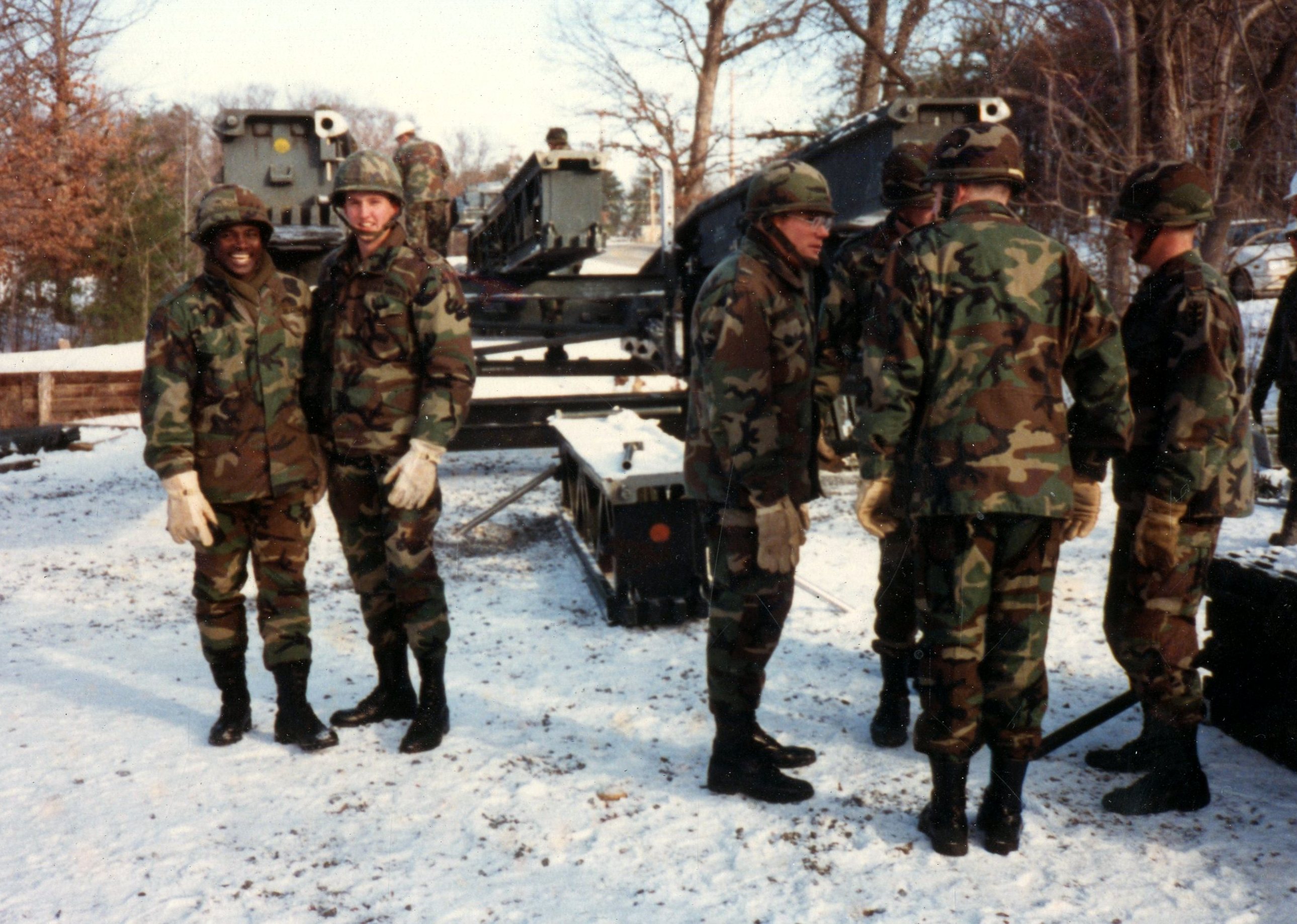
Second Lt. Tom Blackstock with 2nd Lt. Antoine Bodo of the Central African Republic Army conduct medium girder bridge training during the Army
Engineer Officer Basic Course at Fort Belvoir, Va. in January 1988. Photo courtesy of Brig. Gen. Blackstock.

Upon graduating in 1987, Blackstock completed initial branch training and was assigned as a platoon leader with the 27th Engineer Battalion at Fort Bragg. He was promoted to 1st lieutenant in 1989 and mobilized to Saudi Arabia in support of Operation Desert Shield the following year as the executive officer of Company B. As Desert Shield gave way to Desert Storm, Blackstock was assigned as the assistant operations officer for the 27th En Bn. Returning to the United States, he completed the Officer Advanced Course at Fort Leonard Wood before leaving active duty to serve in the Army Reserve.


First Lieutenant Tom Blackstock with the 27th Engineer Battalion in Iraq in 1991. Photo courtesy of Brig. Gen. Tom Blackstock.

In November 1996, Captain Blackstock rejoined the Georgia National Guard as commander of the Marietta-based Headquarters Company, 265th Engineer Group. After a successful command tenure, he was promoted to major and returned to the 265th to serve as the group's logistics officer in 1998. That same year, Blackstock began a civilian career with the Georgia National Guard as an assistant facilities engineer with the Construction Facilities Management Office where he would remain for the next decade.

Captain Tom Blackstock assumes command of Headquarters
Company,265th Engineer Group in November 1996.
Photo courtesy of Brig. Gen. Tom Blackstock.


In November 1999, Blackstock was appointed operations officer for the Statesboro-based 648th Engineer Battalion, an element of the 48th Brigade.


In April 2002 Blackstock was named assistant director of facilities for the CFMO. Promotion to lieutenant colonel followed in June of that year and in April 2003, Blackstock returned to the 648th Engineer Battalion, this time as its commander.


Lieutenant Colonel Tom Blackstock with Soldiers of the 648th Engineer Battalion at the National Training Center at Fort Irwin, Calif.
in January, 2004. Photo courtesy of Brig. Gen. Tom Blackstock.

Following battalion command, Blackstock continued his civilian career in the CFMO and in November 2004 was assigned as deputy commander for the 265th Engineer Battalion, then based in Decatur. From August 2005 to April 2006, Blackstock served as executive officer for the Decatur-based 78th Troop Command. 


December 10, 2010: Major Gen. Maria L. Britt
presents the Meritorious Service Medal to Col.
Thomas H. Blackstock for outstanding leadership
during his two years as commander of the 78th
TC. Georgia National Guard Archives.
Promoted to Colonel in August 2006, Blackstock was appointed to command the 265th Engineer Group and was elevated to director of installation management with the CFMO. As commander of the 265th, Blackstock oversaw the relocation of the unit to Metter in 2007 and continued in command until January 2009 when he was appointed commander of the 78th Troop Command. Blackstock commanded the 78th TC from February 8, 2009 to December 4, 2010 during which time the brigade mobilized nearly 850 Soldiers to Iraq, Afghanistan and the peacekeeping mission in Kosovo.


Concurrent with his assignment as commander of the 78th TC, Col. Blackstock served as the director of operations for the Georgia Army National Guard beginning in March 2010. Leading a staff of 22, Blackstock shepherded the operations directorate through its move to Building 447 at the Clay National Guard Center. In March 2012, Blackstock left the operations directorate and mobilized to Kabul, Afghanistan as the chief of the military technical agreement branch. As the MTA chief, Blackstock worked with Afghan ministries and coalition partners to synchronize efforts and served as the senior national representative for United States forces at International Security Assistance Force headquarters.


Upon returning from Afghanistan, Blackstock was appointed chief of the joint staff of the Georgia National Guard where he developed and executed programs with a staff of 50.


Colonel Tom Blackstock participates in a memorial ceremony at the International Security Assistance Force headquarters in Kabul, Afghanistan
in June 2012. Photo courtesy of Brig. Gen. Blackstock.

In April 2014, Blackstock transitioned to serve as the United States Property and Fiscal Officer for Georgia. As USPFO he served as the representative for the Chief of the National Guard Bureau, managing and executing more than $3 billion in federal property and an annual budget of more than $500 million.


Colonel Tom Blackstock (standing, top-center) with the staff of the United States Property and Fiscal Office, Georgia National Guard in 2014.
Photo courtesy of Brig Gen. Tom Blackstock.

In 2016, Blackstock retired from civil service while continuing forward in his military career. In July 2016 he was appointed to command the 78th Troop Command for a second time. Promotion to Brigadier General followed in September.


CLAY NATIONAL GUARD CENTER, Marietta, Ga., July 10, 2016 – Colonel Tom Blackstock assumes command of the 78th Troop Command
from Brig. Gen. Craig McGalliard during a ceremony. Photo by Sgt. Shye Stallings.

While still in command of the 78th TC, Blackstock was appointed to concurrently serve as the commanding general of the Georgia State Defense Force, a component of the Georgia Department of Defense comprised of more than 500 volunteers who augment National Guard operations during emergency operations. Under his command, State Defense Force volunteers assisted efforts across Georgia as part of the state’s coordinated response to the Coronavirus pandemic. During this response, the State Defense Force completed more mission hours across the state than in any previous domestic operation.

Brigadier General Tom Blackstock with members of the Ga. State Defense force at Fort Stewart, Ga. in 2019. Photo courtesy of Brig. Gen. Tom Blackstock.


During his three years in command of the 78th TC, the brigade deployed eight units overseas in support of Operation Enduring Freedom, Operation Iraqi Freedom, Operation Freedom’s Sentinel and Operation Atlantic Resolve.


VAZIANI, Country of Georgia, August 2, 2017 – Brigadier General Tom Blackstock, commander of the Georgia Army National Guard’s 78th Troop Command
presents coins to Sgt. Caleb Taylor and Cpl. Andrew Fregine of the Ga. ARNG’s 810th Engineer Company at the Vaziani Training Area near Tiblisi,
country of Georgia, where the 810th is conducting combat engineer training in support of Exercise Noble Partner 2017. Photo by Capt. William Carraway.

Continuing in command of the Ga. SDF, Blackstock was appointed to serve as the director of the Joint Staff in Marietta Georgia in August 2019, a role he held until February 2020 when he assumed duties as the director of the Georgia National Guard’s Youth ChalleNGe Program. In his 18 months as the Ga. YCP director, Blackstock oversaw operations at campuses at Fort Stewart, Fort Gordon and Milledgeville directing the efforts of more than 300 teachers, counselors, and career advisors.


On November 24, 2020, Blackstock relinquished command of the Ga. SDF to Brig. Gen. Mark Gelhardt while continuing to serve as the executive director of the National Guard Association of Georgia through August 2021. A longtime resident of Marietta, Blackstock serves as chief executive officer of Arena Leadership Consultants. He is active in community organizations to include the American Legion, Veterans of Foreign Wars, the National Guard Family Support Foundation and National Guard Association.


Governor Brian Kemp presents the Oglethorpe Distinguished Service Medal to Brig. Gen. Tom Blackstock at the state capitol in 2020.
Photo courtesy of Brig. Gen. Tom Blackstock.


Saturday, August 7, 2021

August 7, 1956: Tragedy Strikes the 128th Fighter-Interceptor Squadron

By Maj. William Carraway

Historian, Georgia Army National Guard


Two Georgia Air National Guard pilots of the Atlanta-based 128th Fighter-Interceptor Squadron were killed in a midair collision during an annual training flight over the Atlantic Ocean Aug. 7, 1956. First Lt. James S. Bonner Jr. and 1st Lt. Robert A. Barr, both of Atlanta, were killed when their F-84 Thunderjets collided while flying as part of a four aircraft formation fifty miles from Savannah. Within minutes of the collision, air-rescue units were dispatched but were only able to locate wreckage.[1]

The accident occurred just after 8:35 a.m. as the four Ga. ANG aircraft were flying at 25,000 feet prior to initiating target runs. The first aircraft banked to engage a target towed by another plane. Climbing high, the first pilot was out of position to witness the collision of the second and third planes in formation. The only witness, the pilot of the fourth plane, reported an explosion and was unable to see any parachutes deployed.[2]

James Shepherd Bonner Jr. was born in Nashville, Tenn. Feb. 3, 1929 and grew up in Atlanta where he played football for North Fulton High School. A 1951 graduate of the University of Georgia, Bonner served in the U.S. Air Force during the Korean War. He enlisted in the Ga. ANG Feb. 2, 1953 and commissioned as a 2nd lieutenant in April. He was a partner in a building supply firm as a civilian.

Just weeks before the fatal accident, Bonner survived a night bailout over Macon. On May 6, Bonner and 1st Lt. Charles Cox were enroute to Jacksonville, Fla. at night in two F-84 Thunderjets when Bonner’s instruments started spinning rapidly indicating a possible loss of equilibrium. He struggled to regain control of the aircraft as it descended at the maximum indicated rate of 6,000 feet per minute. At Cox’ urging, Bonner jettisoned the aircraft canopy and ejected. Bonner had just freed himself from his seat and deployed his parachute when he hit the ground in a Kaolin mine. He slept in his parachute and in the morning walked to a nearby road where he was able to hitch a ride to a farmhouse. He was then conveyed to Robins Air Force Base.[3]

Robert Andrew Barr was Born Feb. 18, 1925 in Evanston, Ill. He served as a pilot during World War II and the Korean War. Married with three children, Barr was a partner in an Atlanta-based commercial art firm.

At the time of the accident Bonner and Barr had each flown the F-84 for three years compiling more than 600 combined flight hours. They were memorialized at Marietta National Cemetery. The Atlanta Constitution extended sympathies to the families of the pilots observing “The two Atlanta officers died in the line of duty as surely as if the nation had been in a state of war.”[4]

On August 10, 14 pilots of the 128th Fighter-Interceptor Squadron took to the skies in a flying tribute to Bonner and Barr.[5] The Guardsmen dropped flowers into the sea as a final salute to the fallen pilots.[6]


Pilots of the 128th Fighter-Interceptor Squadron prepare for a flight to honor 1st Lt. James Bonner and 1st Lt. Robert Barr at Travis Field Aug. 10, 1956.
Georgia National Guard Archives.


[1] “Jets Collide High Above the Atlantic.” The Baltimore Sun, Aug. 8, 1956, 3.

[2] “2 Atlanta Guard Jet Pilots Killed in Fiery Crass High Over Atlantic.” The Atlanta Constitution, Aug. 8, 1956, 1.

[3] “Night Bailout over Macon Saves Georgia ANG Pilot” The Georgia Guardsman, May 1956, 5.

[4] “They lost their Lives in the Nation’s Cause.” The Atlanta Constitution, Aug. 9, 1956, 4.

[5] “A Pictorial Review of 1956 Field Training,” The Georgia Guardsman, Sept. 1956, 0.

[6] “Services at Sea Set for 2 Fliers.” The Atlanta Constitution, Aug. 9, 1956, 35.

Thursday, September 3, 2020

Sept. 3, 1950: Training Accident Claims the Lives of Two Ga. ANG Pilots

By Major William Carraway

Historian, Georgia Army National Guard

F-84 Thunderjets of the Georgia Air National Guard fly in formation in 1950. Georgia National Guard Archives.


Two Georgia Air National Guard Pilots of the Marietta-based 128th Fighter Squadron were killed Sunday Sept. 3, 1950 when their F-84 Thunderjet fighters collided in the skies over Dobbins Air Force Base. Killed were 1st Lt. Kenneth M. Goodrum, 26, and 1st Lt. Tom Martin, 25, both of Griffin, Ga.[1] The pilots were conducting flight training in anticipation of possible Korean War mobilization when their aircraft collided at more than 500 miles per hour at an elevation of 20,000 feet. Both men were thrown clear of the wreckage. Goodrum managed to deploy his parachute but did not survive.[2]


Martin was born Nov. 5, 1924 in Griffin, Ga. He enlisted in the U.S. Army December 15, 1942, completed pilot training and was assigned to the 358th Fighter Group.[3] The 358th provided fighter escort to bombing missions over Germany first with the P-47 Thunderbolt and later the P-51 Mustang.[4]


Born June 29, 1924, Goodrum entered Army service June 19, 1943 and served as a flight officer in World War II.[5] Joining the Ga. ANG after the war, Goodrum, served as aide de camp and pilot for Maj. Gen. Ernest Vandiver, Adjutant General of Georgia and frequently flew the general and Governor Herman Talmadge on official visits throughout the state. During the 1949 annual training at Camp Stewart, Goodrum, flying a B-26 Bomber, towed aerial targets for the 90 mm gun crews of the 108th Antiaircraft Artillery Brigade to conduct target practice.[6]


Gravestones of 1st Lt. Kenneth Goodrum and 1st Lt. Tom Martin, Oak Hill Cemetery, Griffin, Ga. Photos by Rebekah Duncan.

The pilots were remembered during a solemn ceremony in Griffin September 5. Both Governor Talmadge and Gen. Vandiver served as pallbearers. Martin and Goodrum were interred at Oak Hill Cemetery in Griffin, Ga.[7]


[1] “Two Air Guard Jet Pilots Meet Death Above Dobbins.” The Georgia Guardsman Magazine, Sept/Oct 1950, 7.

[2] “2 Georgians Killed in Collision of Jets.” The Atlanta Constitution, Sept. 4, 1950, 1.

[3] Headstone Application for Tom A. Martin. Ancestry.com. U.S., Headstone Applications for Military Veterans, 1925-1963 [database on-line]. Provo, UT, USA: Ancestry.com Operations, Inc., 2012.

[4] History: 358th Fighter Group. https://www.trailblazersww2.org/history_358thFG.htm

[5] Headstone Application for Kenneth M. GoodrumAncestry.com. U.S., Headstone Applications for Military Veterans, 1925-1963 [database on-line]. Provo, UT, USA: Ancestry.com Operations, Inc., 2012.

[6] “Anti-Aircraft Field Training Big Success.” The Georgia Guardsman Magazine, August 1949, 7.

[7] “Griffin Rites Today for Guard Pilots” The Atlanta Constitution, Sept 5, 1950, 23.

Sunday, May 24, 2020

Georgia Guard Stories of Sacrifice from the Marietta National Cemetery


By Maj. William Carraway
Historian, Georgia Army National Guard

Memorial Day is a solemn annual observance in which our nation pauses to remember those who gave their lives to secure the blessings of liberty for ourselves and future generations. For this Memorial Day, the Georgia National Guard History office examines the stories of fallen Georgia National Guardsmen from World War II who rest in Marietta National Cemetery.

About the Cemetery
Marietta National Cemetery is the final resting place of nearly 19,000 of our nation’s veterans. The cemetery was established in 1866 as the Marietta and Atlanta National Cemetery to accommodate nearly 10,000 fallen Federal Soldiers from the Atlanta Campaign of the American Civil War.[1] Since that time, the cemetery has served as the final resting place for those who fell in our nation’s wars. Among them are seven members of the Georgia Guard who fell during World War II. The lineage of the units in which these Soldiers fell continue in service today in the Georgia Army and Air National Guard.
 
Sgt. Harold Wood, Co B, 121st Infantry Regiment
Sergeant Harold Milner Wood, Company B, 121st Infantry Regiment
Harold Wood was born April 15, 1902. He enlisted in the Georgia Army National Guard’s Company B. 121st Infantry Regiment based in Barnesville. The Barnesville Blues conducted initial training with the regiment at Fort Jackson, S.C. and continued training during the Carolina and Tennessee Maneuvers. The 121st landed on Normandy’s Omaha Beach July 4, 1944.[2] During the attempt to push entrenched German Soldiers out of La Haye du Puits in Northern France, Wood was killed in action July 13, 1944. He is buried in Marietta National Cemetery, Section K, Grave 4044 B.
 
TSgt. Emmett Asbell, Co M, 121st Infantry Regiment
Technical Sergeant Emmett Asbell, Company M, 121st Infantry Regiment
Emmett Asbell was born September 14, 1915 in Bleckley County, Ga. Asbell enlisted in the Hawkinsville-based Company M, 121st Infantry and rose to the rank of 1st sergeant before his unit was accepted into federal service in September 1940. Like Wood, Asbell completed the pre-deployment training with the 121st Infantry Regiment before fighting his way through the Normandy and Northern France campaigns. He was killed in action November 26, 1944 in Germany and is buried in Marietta National Cemetery, Section K, Grave 2008 I.
 
Lt. Col. William Waldo, 101st SP BN CAC
Lieutenant Colonel William Waldo, Headquarters Company, 101st Separate Battalion, Coast Artillery Corps
William Slayton Waldo was born October 8, 1902. He was a long-time member of the 108th Cavalry having enlisted as a private in April 1921. He was promoted to staff sergeant in 1924, commissioned a second lieutenant in 1925 and promoted to first lieutenant two years later. In 1939, 1st Lt. Waldo served as the adjutant of headquarters, 1st Squadron, 108th Cavalry when it converted to form a coast artillery battalion. Captain Waldo commanded Headquarters Company, 101st Separate Battalion, Coast Artillery Corps when it was accepted into federal service in September 1940. Waldo received promotion to major and lieutenant colonel before mobilizing for the Pacific Theater in 1943. Waldo fell ill while transiting the Panama Canal. He died December 9, 1943 in the Panama Canal Zone. He is buried in Marietta National Cemetery, Section Q, Grave 57.
 
Pvt. Herman D. Brinkley, Co B, 121st Infantry Regiment
Private Herman D. Brinkley, Company B, 121st Infantry Regiment
Herman D. Brinkley of Lamar, Ga. joined the Barnesville Blues, Company B, 121st Infantry Regiment September 16, 1940 at the age of 18. He was killed in action in the vicinity of Isigny-sur-Mer, France July 16, 1944. He is buried in Marietta National Cemetery Section E, Grave 6544-1.
T4 Paull Callaway, Co D, 121st Infantry Regiment

Technician 4th Grade Paul Callaway, Company D, 121st Infantry Regiment
Paul Callaway joined Company D, 121st Infantry as a private January 24, 1941 at the age of 20. Callaway volunteered for airborne service and was assigned to the 551st Parachute Infantry Regiment, 82nd Airborne Division. He was killed in action January 6, 1945 during the Battle of the Bulge. He is buried in Marietta National Cemetery Section K, Grave 10293 C.
 
Pvt. Thomas Hudson, Battery F, 179th FA
Private Thomas F. Hudson, Battery F, 179th Field Artillery
Thomas F. Hudson enlisted as a private in Battery F, 179th Field Artillery October 10, 1939 at the age of 21. He was transferred to the 110th Infantry Regiment, 28th Infantry Division. Private Hudson was killed in action August 2, 1944 near Saint Lo, France. He is buried in Marietta National Cemetery Section K, Grave 4002 E.
 
The 128th OS, May 1941
Technical Sergeant Thomas L. Johnson, 128th Observation Squadron
Thomas Johnson enlisted in the 128th Observation Squadron at the age of 23 on March 31, 1941. In March 1943, the 128th was redesignated the 21st Antisubmarine Squadron and assigned B-25 Mitchells. On July 23, 1943, Thomas’ aircraft went missing in flight from Gulfport to Tampa. Also missing on the flight were 1st Lt. John Turner, TSgt. Edward Simpson and TSgt. J. R. Grogan, all of the Ga. National Guard. Johnson is memorialized in College Park Cemetery and Marietta National Cemetery, Section MA, Grave 4.

Photos courtesy of the Georgia Army National Guard Archives


[1] Marietta National Cemetery, https://www.cem.va.gov/cems/nchp/marietta.asp
[2] Carraway, William. It Shall Be Done:  The 121st Infantry Enters Fortress Europe. July 26, 2019. http://www.georgiaguardhistory.com/2019/07/it-shall-be-done-121st-infantry.html

Blog Archive